TCF Canada Practice Tests: Official Samples and Free Practice by Section
There is no large public bank of TCF Canada papers. France Éducation international publishes a small number of official samples, and after those you are assembling practice yourself. This guide shows what exists, what each piece is good for, what score you are aiming at, and how to turn it all into a timed rehearsal.
What a full TCF Canada paper looks like
Know the shape before you practise. Most of the value in a mock exam comes from the clock, not the questions.
The score you are actually practising for
Practice without a target number is just reading French. For immigration, the number is a CLB level, and it is not an average.
CLB 7 in all four skills is the usual minimum for mainstream federal programmes. CLB 8 and 9 are where the extra points start to matter. Work out where you currently stand with the CLB converter, then read the full breakdown in the TCF-to-CLB guide.
Official sample papers from France Éducation international
France Éducation international runs the TCF and publishes the only samples written by the people who write your exam. They belong at the top of any free study plan.
Website: france-education-international.fr
A corrected expression écrite sample, free to download
What free material almost never gives you is a finished answer to measure your own against. We publish one.
TCF Canada – expression écrite: corrected sample answer (PDF)
25 pages, no registration. Inside:
- A model answer for each of the three tasks, with the analysis of why it works
- The assessment criteria examiners apply, and what each one is asking for
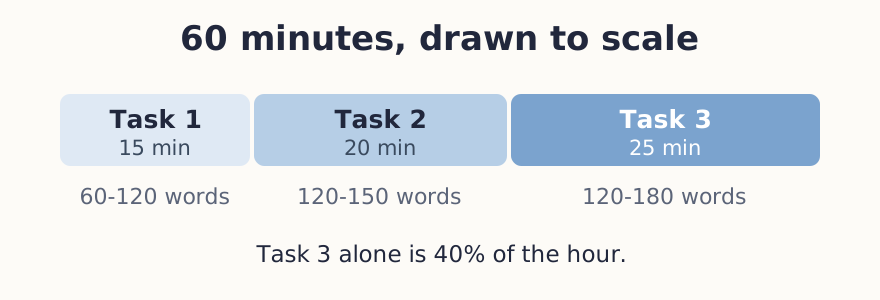
- A blank answer sheet laid out like the real thing: 60 minutes, with the line counts each task allows
Print the answer sheet, set a timer for 60 minutes, write all three tasks, and only then read the model. Reading it first turns a rehearsal into a comprehension exercise.
Free practice, section by section
Each module has a different free-resource landscape. Listening and reading are well served by general French media; writing and speaking thin out fast, because both need someone to tell you what was wrong.
Compréhension orale — 39 questions, 35 minutes
The audio plays once. Most lost marks are not vocabulary, they are the traps built into how the question is worded — and the Quebec accent, which catches people who prepared only on French-from-France material.
Compréhension écrite — 39 questions, 60 minutes
Sixty minutes for 39 questions is about 90 seconds each, and the texts lengthen as the module climbs in difficulty — so the clock, not the vocabulary, is usually what costs the marks.
Expression écrite — 3 tasks, 60 minutes
This is the module where practice pays back fastest, because the three task shapes repeat at every sitting.
Expression orale — 3 tasks, 12 minutes
Twelve minutes, and only Task 2 gives you preparation time — two minutes. Task 3 expects you to start speaking the moment you have the topic.
Building a mock exam out of free material
You can rehearse the whole paper without buying anything. The point is the clock and the order, not the size of the question bank.
Do it in one sitting. The real day is not laid out quite like this — the speaking test is a separate face-to-face appointment with an examiner — but stamina is the thing free practice never trains, and the fatigue in the last twenty minutes of reading is worth meeting before it counts.
A six-week plan
Six weeks is enough to move one weak section, and the plan works because it spends the first week finding out which section that is rather than assuming.
Where free practice runs out
Free material tells you the format and lets you rehearse the clock. What it cannot do is tell you why a particular sentence of yours would cost a mark.
For the two comprehension modules that gap barely matters: the answers are objectively right or wrong, and the limit on your score is reading and listening ability you can build from any good material.
For writing and speaking it is the whole problem. You can write twenty Task 3 essays and repeat the same subjunctive error in all twenty without ever being told — and because CLB 7 is 10–11 out of 20 and CLB 8 is 12–13, a single point is the whole distance between them.
That is the point at which marked feedback is worth more than another sample paper. SavoirX scores TCF Canada writing against the official criteria with AI, and returns each correction with the reason behind it.
Frequently asked questions
Are there official TCF Canada practice tests? Yes, but very few. France Éducation international publishes samples; there is no large public bank. Remember the comprehension modules in the real exam are adaptive, which a fixed sample cannot reproduce.
What is a good score on a TCF practice test? Score each module separately and convert with the table above. CLB 7 across all four skills is the usual minimum for mainstream federal programmes; CLB 9 is where the extra points become significant.
How many times can I sit the TCF Canada? Thirty days between attempts, with no limit on how many times you sit it — and each one is paid. That is the real argument for rehearsing properly before you book — see how long to wait before retaking.
Is TCF Canada harder than DELF? Different, not harder. TCF measures your current level across all four modules and reports a score; DELF certifies one target level and you pass or fail it. See TCF Canada vs DELF.
How long are my results valid? Two years from the test date. The validity guide covers how that interacts with an immigration timeline.
Can I practise TCF writing without a teacher? Up to a point. You can learn the task shapes and rehearse the timing alone. What you cannot do alone is spot an error you do not know is an error — that needs either a marker or an AI that applies the same criteria.