
If you are preparing to immigrate to Canada, understanding exactly what the TCF Canada writing section tests and how it is scored is the starting point of your entire preparation. TCF Canada is an official French exam designed specifically for candidates planning to immigrate to Canada. Its writing section contains three tasks, each with a different objective and scoring focus. Understanding these requirements and the logic behind the scoring will help you avoid detours and better demonstrate your language skills in the exam.
With this goal in mind, we'll first get an overall view of the writing tasks and requirements, and then look at how examiners actually grade your performance.
Quick orientation
This guide covers all 3 tasks, score-level mapping, examiner criteria, and model answers with analysis so you can prepare in a structured way.
Writing Tasks and Score Distribution
Before getting into scoring details, start by understanding what each of the three tasks asks for. That makes your time management and answering strategy much clearer.
- Task 1: Short text (60–120 words)
- Suggested time: 15 minutes
- Main focus: Whether you can clearly convey basic information (e.g. thanks, requests, describing small events) and whether your sentences are simple and clear.
- Task 2: Medium-length text (120–150 words)
- Suggested time: 20 minutes
- Main focus: Whether your text has a complete structure, your ideas are clearly expressed, and your language is smooth and natural.
- Task 3: Longer text (120–180 words)
- Suggested time: 25 minutes
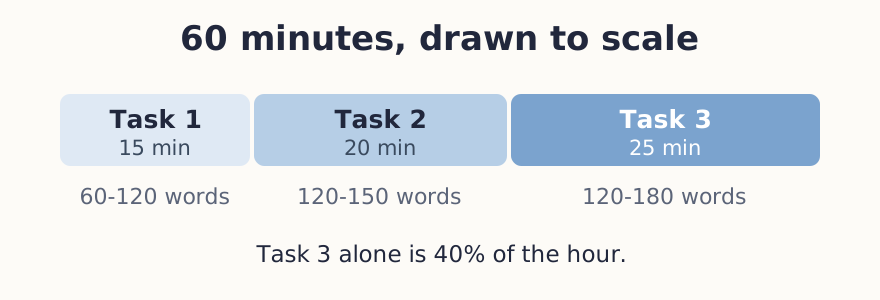
- Main focus: Whether you can analyze and argue, whether your logic is clear, and whether your arguments are explicit and show a certain level of depth.
Tip: You need to allocate your time reasonably for all three tasks and read the instructions carefully to make sure each task hits the required points.
The three tasks get progressively harder: Task 1 is the simplest, Task 2 starts to demand structure, and Task 3 carries the most marks and separates candidates the most.
Score Levels and Correspondence
Once you understand the basic purpose of each task, the next question most students care about is: What level do these performances correspond to?
When preparing, the key concern is always the relationship between scores and levels. Below we briefly compare the writing scoring systems of TCF Canada and DELF.
TCF Canada
- Total score 20 points (writing section).
- Conversion Converted into CLB (Canadian Language Benchmarks) and aligned with CEFR.
- Correspondence
- 0–3 points → A1
- 4–6 points → A2
- 7–9 points → B1
- 10–12 points → B2
- 13–15 points → C1
- 16–20 points → C2
For immigration applications, the usual requirement is CLB 7–9 (roughly B2 level).
From the conversion chart, we can clearly see that your writing score directly determines whether you meet the language requirement for your immigration application.
DELF
- Total score 100 points (writing: 25 points).
- Pass mark 50 points (with each section ≥ 5 points).
- Features
- A1: 40–60 words
- A2: 80–100 words
- B1: at least 160 words
- B2: at least 250 words
- You only get the certificate of the level you register for (no crossing levels).
Score & Level Overview Table
If you want to learn more about the differences between TCF Canada and DELF, you can read our full comparison article: TCF Canada vs DELF: A Complete Comparison for more detailed information!
Once you understand the relationship between score – level – purpose, the next key question is: What exactly are examiners looking at? That brings us to the next part: the scoring criteria.
Overview of TCF Canada Writing Scoring Criteria
Knowing how the score is converted is only the first step. What actually raises your score is knowing what the examiner looks for in each task. What actually helps you improve your score is understanding what the examiner is specifically looking for behind each task.
In this section, we present the key elements of TCF Canada writing evaluation to help you understand how to target the criteria and earn higher scores.
- Content relevanceDoes the text respond to the task? Does it stay focused on the requirements? Does it answer the questions asked in the prompt?
- Language accuracyAre your grammar structures correct? Are your spellings accurate? Is punctuation used appropriately?
- Clarity of expressionIs your language clear and concise, avoiding unnecessarily long or overly complex sentences? Are you avoiding redundant words and vague phrasing?
- Structure and logicDoes your text have a clear introduction, body, and conclusion? Are the transitions between paragraphs natural? Is the overall line of thought easy to follow?
- Lexical varietyDo you use a range of vocabulary and sentence structures? Do you avoid repeating the same words over and over? This variety makes your writing read as more sophisticated.
High-score formula in one line:On-topic + Accurate grammar + Varied vocabulary + Clear logic. If you can do these four things, you're already in a strong position to score well.
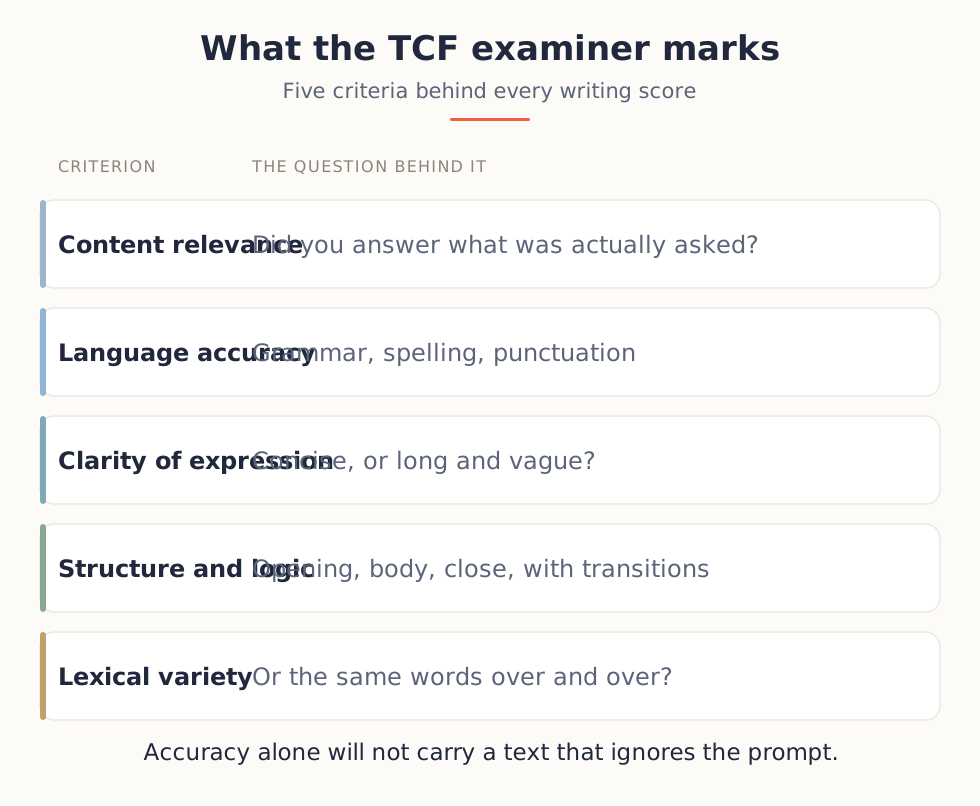
As you can see, the scoring criteria test concrete skills that can be trained. Next, we'll use realistic prompts and model answers to show how these criteria are applied in practice.
TCF Canada Writing Task Examples – Full Breakdown
The model answers below, the criteria they are measured against, and a blank timed answer sheet are also available as a TCF Canada writing sample (PDF).
Once you understand the overall requirements and scoring logic, the most effective way to learn is to work through concrete examples and see how to approach each task.
In the following sections, we'll analyze Task 1, Task 2, and Task 3 one by one, moving through four dimensions: task instructions → sample answer → detailed analysis → useful expressions, so you can build a clear, reusable framework for writing.
Use each section as a reusable pattern: read instruction, identify required points, then replicate the structure in your own writing.
Task 1: Short Email Writing Example (60–120 words)
Task 1 is the simplest of the three tasks. It mainly tests whether you can express yourself clearly and politely in a simple, everyday situation. For more examples and templates, see our complete Task 1 guide.
Task 1 focus: accuracy and clarity in short practical messages.
Task Requirements
- Format: Text message, note, or short email in everyday contexts.
- Content: Usually about one specific event, such as expressing thanks, making a request, or making a recommendation.
- Word count: 60–120 words.
- Suggested time: 15 minutes (Planning 3′ + Writing 8′ + Checking 4′).
Time management tips:
- 3 minutes planning: quickly decide on the travel destination, dates, 2–3 activities, and your recommendation.
- 8 minutes writing: write in a logical order; don't get stuck on small details.
- 4 minutes checking: focus on verb conjugations and spelling.
If you keep this basic structure in mind, a routine email prompt won't cost you time in the exam.
Task Instructions
En français Vous écrivez à un(e) ami(e) pour lui raconter votre dernier voyage. Indiquez le lieu et la date du voyage, quelques activités ou expériences vécues, la partie que vous avez préférée et terminez par une recommandation pour votre ami(e).
Explanation in English You need to write an email to a friend to tell him or her about a recent trip you took. You should mention the destination and dates of the trip, some activities or experiences you had, the part you liked the most, and finish with a recommendation for your friend.
Sample Answer
Réponse modèle - Tâche 1 · 95 words
Objet : Mon voyage à Paris
Salut Marie,
Je voulais te parler de mon dernier voyage à Paris ! Je suis parti avec ma famille la semaine dernière, et c'était incroyable ! Nous avons visité des sites comme la Tour Eiffel et le Louvre.
Ce que j'ai préféré, c'est de flâner dans les rues et de goûter la nourriture locale. Les croissants étaient délicieux ! Je te recommande vivement Paris, surtout si tu aimes l'art et la culture.
J'espère qu'on pourra y aller ensemble un jour !
À bientôt,
[Ton prénom]
Exam tip: keep the sequence stable and make sure every required point appears explicitly.
Detailed Analysis
Opening greetingSalut Marie… sounds natural and friendly. Suggestion: you can also add J'espère que tu vas bien to make it sound even more considerate.
Time and placeJe suis parti la semaine dernière à Paris… clearly sets the context. Tip: use passé composé here, such as J'ai visité…, to make your writing more standard and accurate.
Activity description Mention a few typical activities, such as la Tour Eiffel, le Louvre. Suggestion: use comme or par exemple to make sentences flow better.
Expressing feelingsCe que j'ai préféré, c'est… is a very useful structure. Suggestion: you can also use J'ai particulièrement aimé… for more lexical variety.
Recommendation and closingJe te recommande vivement Paris… is simple and strong. Tip: add a reason, e.g. Je te recommande Paris parce que c'est magnifique.
By breaking it down layer by layer, you can see that Task 1 is really not that difficult. The key is: cover all the required information and keep the structure smooth.
Useful Expressions to Memorize
- J'espère que tu vas bien.
- Je suis parti(e) … la semaine dernière.
- Ce que j'ai préféré, c'est …
- J'ai particulièrement aimé …
- Je te recommande vivement …
If you get familiar with and memorize a few such fixed patterns, you'll be able to write quickly in the exam without getting stuck at the opening or the conclusion.
Task 2: Event Description and Opinion (120–150 words)
After mastering Task 1 (information-focused writing), Task 2 starts asking you to add opinions and evaluation on top of your narration. For high-scoring templates and phrases, check out our detailed Task 2 guide.
Task 2 focus: clear structure + personal reaction + smoother transitions.
Task Requirements
- Format: Letter, short article, or mini-essay.
- Content: Describe an event and add your feelings or opinion about it.
- Word count: 120–150 words.
- Suggested time: 20 minutes (Planning 4′ + Writing 12′ + Checking 4′).
Time management tips:
- 4 minutes planning: think about the event name, time, 1–2 highlights, and your personal feelings.
- 12 minutes writing: organize with "Tout d'abord, Ensuite, Enfin".
- 4 minutes checking: check sentence completeness and logical coherence.
As you can see, Task 2 builds on complete information and puts more emphasis on structure and personal viewpoint. It's also an important bridge toward Task 3.
Task Instructions
En français Pour le journal de votre école, vous racontez votre participation à une course de vélo. Vous indiquez la date et le lieu de l'événement, décrivez l'ambiance et vos impressions, puis vous terminez par une recommandation à vos camarades.
Explanation in English You need to write a short article for your school newspaper describing your experience taking part in a cycling race. You should state the time and place of the event, describe the atmosphere and your feelings, and finish with a recommendation to your classmates.
Sample Answer
Réponse modèle - Tâche 2 · 130 words
Titre : Ma participation à la course de vélo
La semaine dernière, j'ai participé à une course de vélo organisée dans ma ville. Cet événement a eu lieu le dimanche matin et a attiré de nombreuses personnes de tous âges. La course a parcouru un circuit de 15 kilomètres, et c'était très amusant.
J'ai adoré l'ambiance de l'événement. Tout le monde était enthousiaste et se soutenait mutuellement. C'était également une excellente occasion pour moi de faire de l'exercice tout en m'amusant.
Si tu aimes le sport et la convivialité, je te recommande vivement de participer à cet événement l'année prochaine. C'est une expérience à ne pas manquer !
Exam tip: Task 2 should sound more personal than Task 1 while staying coherent and concise.
Detailed Analysis
Introducing the eventLa semaine dernière, j'ai participé à… is simple and direct. Suggestion: you can add a quick evaluation such as C'était une expérience inoubliable to make the opening more engaging.
Event details Describe 1–2 highlights such as the number of participants and the atmosphere. Tip: the background and atmosphere can use imparfait (e.g. Il faisait beau, tout le monde souriait).
Expressing feelingsJ'ai adoré l'ambiance… sounds natural. Suggestion: try other emotional verbs like apprécier or profiter de to avoid using adorer all the time.
Recommendation and closingJe te recommande vivement… is clear and strong. Suggestion: add a reason with parce que… to sound more sincere.
With this step-by-step analysis, you can see that Task 2 is Task 1 with one more step: you add what you think about the event.
Useful Expressions to Memorize
- La semaine dernière, j'ai participé à …
- Il y avait beaucoup de monde …
- J'ai adoré / J'ai apprécié …
- C'était une excellente occasion de …
- Je te recommande vivement de …
If you prepare these expressions in advance, you can combine them directly in the exam instead of building every sentence from scratch.
Task 3: Summary and Opinion (120–180 words)
Once you're comfortable with Task 1 and Task 2, Task 3 is the most demanding of the three. It tests your combined skills in reading comprehension + information synthesis + opinion + argumentation. For advanced strategies, see our detailed Task 3 guide.
Task 3 focus: concise synthesis first, then justified opinion with balanced logic.
Task Requirements
- Format: Write an argumentative text based on two short texts.
- Content: First summarize the main ideas of the two texts, then express your own opinion and justify it.
- Word count: 120–180 words.
- Suggested time: 25 minutes (Summary 7′ + Opinion & Argument 13′ + Checking 5′).
Time management tips:
- 7 minutes planning: summarize the core ideas of the two texts and decide your stance.
- 13 minutes writing: follow a four-paragraph structure: "Summary → Opinion → Argumentation → Conclusion".
- 5 minutes checking: check logical flow and word count.
As long as you firmly remember this 4-paragraph structure, Task 3 won't turn into a chaotic block of text in the exam.
Task Instructions
En français
Voici deux textes à lire :
Consigne
Après avoir lu deux textes :
- Le premier texte présente les avantages de la vie en ville (commodité, diversité culturelle, transports).
- Le deuxième texte présente les avantages de la vie à la campagne (tranquillité, nature, air pur).
Écrivez un texte dans lequel vous résumez les deux points de vue, puis exprimez votre propre opinion en la justifiant.
Explanation in English First, summarize the viewpoints of the two texts (city life: convenient and diverse; countryside life: quiet and natural). Then state your own preference and give your reasons.
Sample Answer
Réponse modèle - Tâche 3 · 175 words
Titre : Vie en ville ou à la campagne ?
Les deux textes présentent deux opinions opposées. Le premier met en avant les avantages de la vie en ville, comme la commodité, les services rapides et la diversité culturelle. En revanche, le second valorise la vie à la campagne, soulignant la tranquillité, la nature et un air plus pur, favorisant un mode de vie plus équilibré.
Pour ma part, je préfère la vie en ville, même si la campagne a ses avantages. En ville, tout est plus pratique : les transports sont fréquents, il y a des magasins, des restaurants et des activités culturelles à proximité. Par exemple, j'adore aller au théâtre ou au musée pendant le week-end. De plus, vivre en ville permet de rencontrer plus de gens, ce qui est idéal pour ceux qui aiment la diversité et l'animation.
Cependant, je reconnais que la vie à la campagne offre une tranquillité que l'on ne trouve pas en ville. La nature, l'air pur et l'absence de bruit sont des avantages non négligeables.
Mais pour moi, les avantages de la ville l'emportent. Le dynamisme, la culture et la facilité d'accès aux services sont les éléments qui rendent la vie urbaine plus attrayante.
Exam tip: prioritize clear synthesis before opinion; Task 3 is graded heavily on logic and argument flow.
Task Analysis
Summarizing the two texts
Le premier texte met en avant les avantages de la vie en ville… / le second valorise la vie à la campagne, soulignant…
This accurately summarizes the core ideas of the two texts without copying the original wording and uses verbs like met en avant / valorise / soulignant, which makes the language flexible and natural.
Suggestion: using synonyms like this shows your lexical flexibility.
Introducing your stance
Pour ma part, je préfère… creates a smooth transition into your own opinion.
Suggestion: you can also use Selon moi / Quant à moi / D'après moi for variety and a more dynamic reading experience.
Developing your argument
For example: J'adore aller au théâtre ou au musée… — this is concrete and relevant to city cultural life, effectively supporting your point.
Tip: add causal connectors such as car / parce que / ce qui permet de… to make your reasoning more complete.
Acknowledging the other side
Cependant, je reconnais que… shows you acknowledge the advantages of life in the countryside, which makes your argument more balanced and objective.
Suggestion: keep the structure "acknowledge the other side + return to your position" to strengthen your logic.
Wrapping up
Mais pour moi, les avantages de la ville l'emportent. Even without starting with En conclusion, this sentence clearly serves as a conclusion and reinforces your stance.
Suggestion: if you want to sound more formal, use En conclusion / Pour toutes ces raisons to give a stronger sense of completeness.
Through this example, you can clearly connect the evaluation criteria with concrete expressions and understand why this kind of answer earns a good score.
Useful Expressions to Memorize
- Le premier texte présente … / Le deuxième texte souligne que …
- Pour ma part / Selon moi …
- Par exemple …
- Cependant, je reconnais que …
- En conclusion / Pour toutes ces raisons …
These expressions work for city versus countryside, and transfer just as well to technology versus tradition, online versus in-person classes, and almost any other Task 3 topic. They are worth memorizing.
Study Tips for Writing Preparation
To finish, here are some practical tips to help you score well on the TCF Canada writing section:
- Practice writing regularly Use mock tests and past papers to get used to the different task types and requirements.
- Manage your time Make sure you finish each task within the suggested time so you don't run over.
- Keep a clear structure Whether it's a short or long text, always ensure there is a clear introduction, body, and conclusion.
- Review grammar and spelling Regularly check your writing for common errors such as verb conjugations and tense usage.
- Seek feedback and revise After finishing a piece of writing, check for spelling and grammar errors, and reflect on whether any parts are unclear. If possible, ask someone else to correct it or give you feedback.
With the above explanations, you should now have a solid understanding of the TCF Canada writing section and be better equipped to prepare for it.
Don't forget: if you master the techniques and practice in advance, you'll be able to achieve a great score much more easily!
Real TCF Canada tasks, scored like the exam
Months of preparation come down to a few hours in one room. Practise on TCF Canada B1-B2 tasks until nothing on the paper can surprise you.
- 260+ writing tasksBuilt by our content team to the official TCF Canada format and marking criteria.
- Topics refreshed each quarter100 expert-curated writing topics, aligned with current exam trends.
- Examiner-standard markingScored against the official grid, with your level estimated.
- Detailed feedback on every errorWhy it costs you points, plus a model rewrite to learn from.
Free to start. Cancel anytime.
Or see how SavoirX prepares you for TCF Canada