
Writing Task 1 is the first task in the TCF Canada exam. It mainly evaluates whether you can express basic emotions and information in a clear and concise way in everyday life contexts. In this task, you will typically be asked to write a short message, note, or letter. For an overview of all three writing tasks, see our TCF Canada Expression Écrite guide. Let's take a look at the task requirements, scoring criteria, and some useful techniques!
- Task type Short message / note / letter
- Word count 60-120 words
- Recommended time 15 minutes
- Main focus Clear, concise, and accurate communication
Task Requirements
First of all, the format of this task is usually a short letter, note, or short description. The content revolves around practical issues in daily life, such as inviting a friend, writing to a family member, or asking for information. You must complete the task in 60–120 words, so writing too much or too little will affect your score. It is recommended that you complete this task in 15 minutes, keeping your thoughts clear and your expression concise.
Recommended time allocation: It is suggested to dedicate 15 minutes to Task 1. Although simple, this task requires you to quickly organize your thoughts and ensure that your language is concise and accurate while avoiding overly lengthy expressions.
Scoring Criteria
Now, let’s take a look at how to score well on TCF Canada Writing Task 1. The scoring mainly focuses on three aspects:
- Content completeness (3 points)
- Did you answer the question correctly? Did you mention key information such as the time, place, and reason for the event? Make sure you meet every requirement listed in the prompt!
- Language accuracy (2 points)
- Grammar and spelling carry real weight here. Use correct grammar and avoid spelling mistakes to make your writing smooth and accurate.
- Clarity of expression (1 point)
- Express your ideas clearly and concisely. Avoid unnecessarily complex sentence structures and aim for clarity.
Writing Techniques and Preparation Tips
When preparing for Task 1, remember these useful strategies:
- Conciseness Task 1 has a strict word limit, so keeping your language direct and concise is essential. Avoid long-winded expressions; every sentence should serve a purpose.
- Grammar accuracy Basic grammar must be correct. Make sure your verb tenses and subject-verb agreement are accurate and avoid complicated sentences.
- Emotion expression Ensure your tone and emotion sound natural and sincere. Depending on the task, you can use expressions for gratitude, requests, or suggestions.
With proper time management, you can complete this task in 15 minutes, ensuring clear content and accurate language. This helps you perform well on Task 1 and leaves you more time for the later tasks.
Below is a suggested time management table you can follow during your writing practice:
Four Common Themes in TCF Canada Writing Task 1
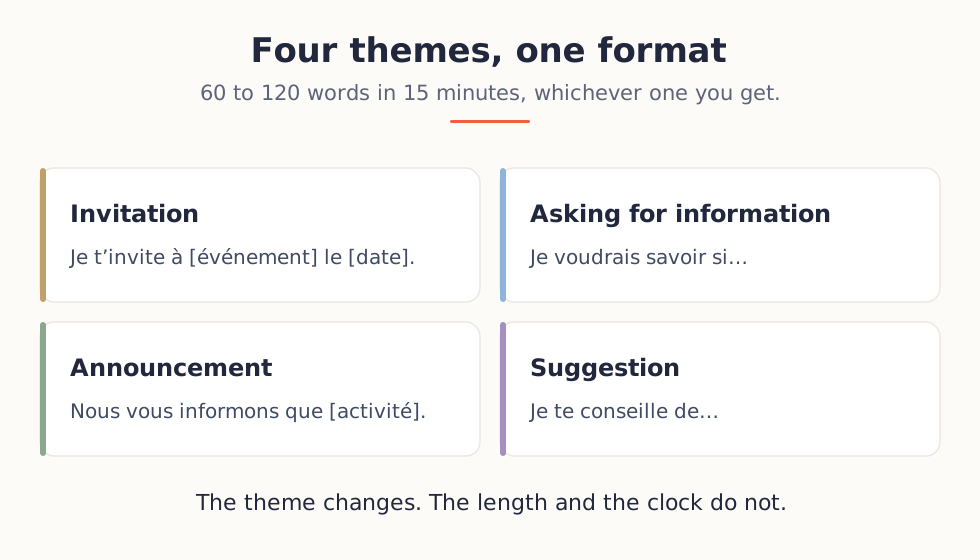
In TCF Canada Writing Task 1, you will encounter four common types of topics. Each type has different writing focuses. Understanding these types helps you prepare better for the exam. Let's take a look at each one:
1. Invitation
In the invitation type of task, you need to invite a friend, colleague, or family member to attend an event. You must clearly mention the event’s time, place, content, and the reason why you want him/her to participate.
Example:
Below is an example of an invitation task:
En français Vous écrivez à un ami pour l'inviter à un événement que vous allez organiser. Indiquez le nom et la date de l'événement, le lieu, ainsi que la raison pour laquelle vous souhaitez qu'il/elle participe.
Explanation in English You need to write an email to a friend inviting him/her to an event you will organize. Mention the name and date of the event, the place, and the reason why you want him/her to come.
Invitation Letter:
Objet : Invitation à ma fête d'anniversaire
Salut Sophie,
J'espère que tu vas bien ! Je t'invite à ma fête d'anniversaire ce samedi 12 juin à 17h chez moi. Nous allons passer un moment agréable avec de la musique, des jeux et bien sûr, plein de bonne nourriture.
Je serais ravie que tu sois présente, cela fait longtemps qu'on ne s'est pas vues ! Ce serait super de célébrer ensemble et de passer un bon moment. J'attends ta réponse avec impatience !
À très bientôt !
Amicalement, Ton prénom
Analysis
- Opening — "J’espère que tu vas bien !" is a warm, friendly greeting that sets the right informal tone.
- Event details — "ma fête d’anniversaire ce samedi 12 juin à 17h chez moi" clearly covers name, date, time, and location in one sentence.
- Highlights — "Nous allons passer un moment agréable avec de la musique, des jeux et bien sûr, plein de bonne nourriture" makes the event sound appealing.
- Reason — "Cela fait longtemps qu’on ne s’est pas vues !" adds emotional motivation for the invitation.
- Closing — "J’attends ta réponse avec impatience !" and "À très bientôt !" end warmly and encourage a reply.
Useful Expressions
2. Requesting Information
In the requesting information type of task, you need to ask someone for specific details or help. The focus of this task is the clarity of your questions and the politeness of your tone.
Example:
Below is an example of a request for information topic commonly seen in TCF Canada Writing Task 1:
En français Vous écrivez à une entreprise pour demander des informations concernant un produit ou un service. Indiquez de quel produit ou service il s'agit, précisez les détails que vous souhaitez connaître et terminez par une demande de réponse.
Explanation in English You need to write an email to a company asking for information about one of their products or services. Indicate clearly which product or service you are referring to, specify the details you want to know, and end by requesting a reply from the company.
Request Letter:
Objet : Demande d'information sur le service de livraison
Bonjour,
Je m'appelle Ton prénom et je m'intéresse à votre service de livraison pour les commandes en ligne. Je voudrais savoir si vous proposez une livraison gratuite pour les commandes supérieures à 50€. De plus, pourriez-vous m'informer sur les délais de livraison pour les produits en stock ?
Je vous remercie d'avance pour votre réponse et j'attends vos informations avec impatience.
Cordialement, Ton prénom
Analysis
- Opening — "Je m'appelle Ton prénom et je m'intéresse à..." introduces yourself and the topic, setting a polite professional tone.
- Specific request — "Je voudrais savoir si vous proposez une livraison gratuite pour les commandes supérieures à 50€" states a clear, specific question.
- Closing — "Je vous remercie d'avance pour votre réponse" politely expresses gratitude and requests a reply. "Cordialement" is the standard formal sign-off.
Useful Expressions
3. Announcement
In the announcement type of task, you need to clearly and accurately publish a notice, usually about schedule arrangements, time changes, or important updates.
Example:
Below is an example of an announcement topic commonly seen in TCF Canada Writing Task 1:
En français Vous écrivez une annonce pour informer vos collègues ou vos amis d'un changement d'horaire ou d'une nouvelle activité. Indiquez le contenu du changement ou de la nouveauté, la date et l'heure, ainsi que le lieu de l'activité ou de l'événement.
Explanation in English You need to write an announcement informing your colleagues or friends about a schedule change or a new activity. State clearly what the change or new event is, the date and time, and the location of the activity or event.
Announcement:
Objet : Changement d'horaire pour la réunion de demain
Chers collègues,
Nous vous informons que la réunion de demain, initialement prévue à 9h, a été déplacée à 14h. Elle se tiendra dans la salle de conférence au troisième étage.
Merci de bien vouloir confirmer votre présence avant midi aujourd'hui.
Cordialement, Votre nom
Analysis
- Opening — "Chers collègues," is formal and appropriate for a professional setting.
- Change details — "la réunion de demain, initialement prévue à 9h, a été déplacée à 14h" clearly states the exact change in one sentence.
- Location — "Elle se tiendra dans la salle de conférence au troisième étage" gives precise location.
- Closing — "Merci de bien vouloir confirmer votre présence avant midi aujourd’hui" is a polite request with a specific deadline.
Useful Expressions
4. Suggestion
In the suggestion type of task, you need to give advice or recommendations to someone to help him/her make a decision in a certain situation. This task requires you to express your suggestion clearly and concisely and provide the reason behind it.
Example:
Below is an example of a suggestion topic from TCF Canada Writing Task 1:
En français Vous écrivez à un ami qui a des difficultés à gérer son emploi du temps. Faites-lui une suggestion pour l'aider à mieux organiser son temps et expliquez les raisons pour lesquelles vous lui proposez cette solution.
Explanation in English You need to write an email to a friend who is struggling with time management. Give one suggestion to help him/her organize time better, and explain the reason why you are proposing this solution.
Suggestion Letter:
Objet : Suggestion pour mieux organiser ton emploi du temps
Salut Marie,
J'ai appris que tu as du mal à gérer ton emploi du temps ces derniers temps, surtout avec toutes les tâches que tu dois accomplir. Je pense que cela pourrait t'aider si tu fais une liste de tes priorités chaque matin, en te concentrant sur les tâches les plus urgentes et importantes.
Cela t'aidera à mieux structurer ta journée et à éviter de te sentir submergée. En plus, cela te permettra de mieux organiser ton temps et d'éviter de procrastiner. Je suis sûr que cela te soulagera un peu !
N'hésite pas à me dire ce que tu en penses.
À bientôt ! Ton prénom
Analysis
- Opening — "J’ai appris que tu as du mal à gérer ton emploi du temps..." introduces the friend’s problem, setting context for the advice.
- Suggestion — "Je pense que cela pourrait t’aider si tu fais une liste de tes priorités..." proposes a practical, concrete solution.
- Reason — "Cela t’aidera à mieux structurer ta journée et à éviter de te sentir submergée." explains why the advice is helpful.
- Closing — "N’hésite pas à me dire ce que tu en penses." encourages a reply and keeps the tone friendly.
Useful Expressions
TCF Canada Task 1 Universal Writing Template
After reviewing several examples of common task types, you may notice that although the requirements differ, the writing structure is actually very similar. Below is a universal writing template to help you quickly apply it during the exam and ensure your text is complete and smooth.
How to use this template quickly: Start with the opening formulas, select the matching main-body lines based on task type, then finish with the right closing style and connectors.
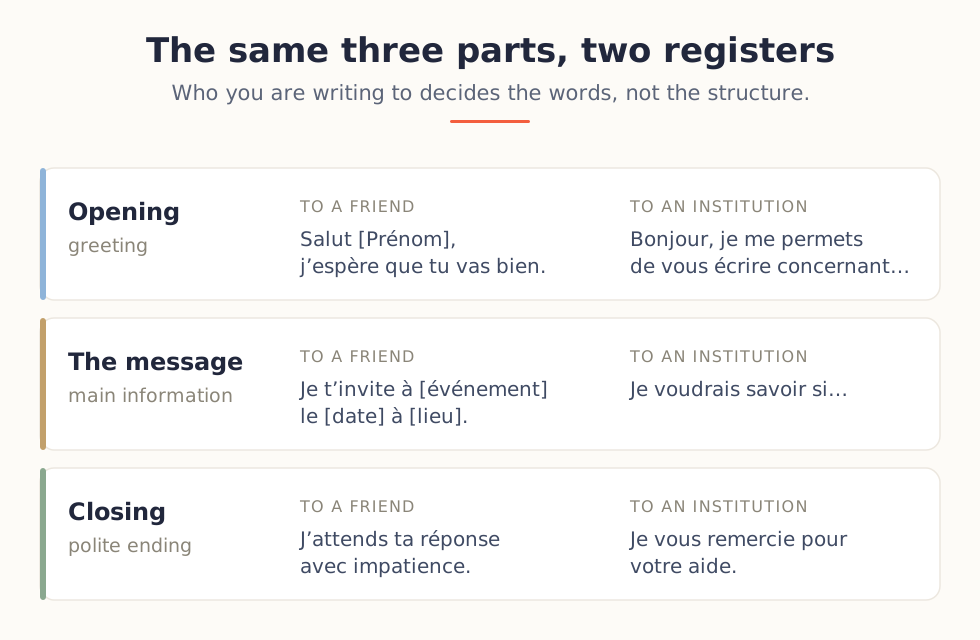
1. Opening Templates (Greeting / Introduction)
Friendly & informal (writing to a friend/acquaintance)
- Salut Prénom, j'espère que tu vas bien.
- Je voulais te dire…
- Cela fait longtemps qu'on ne s'est pas vus !
Formal situations (writing to an institution/company)
- Bonjour, je me permets de vous écrire concernant…
- Je souhaiterais avoir des informations à propos de…
- Je vous écris pour vous informer que…
2. Main Body Templates (Information / Request / Explanation)
Invitation
- Je t'invite à événement le date à lieu.
- Nous allons passer un moment agréable avec activités.
- Ce serait super de célébrer ensemble.
Requesting Information (Demande d'information)
- Je voudrais savoir si…
- Pourriez-vous m'indiquer les détails concernant… ?
- Je vous remercie d'avance pour votre réponse.
Announcement
- Nous vous informons que activité/changement.
- L'événement aura lieu le date à lieu.
- Merci de confirmer votre présence avant délai.
Suggestion
- Je pense que cela pourrait t'aider si…
- Je te conseille de…
- Cela t'aidera à mieux résultat attendu.
3. Closing Templates (Politeness / Expectation)
Informal
- J'attends ta réponse avec impatience.
- N'hésite pas à me dire ce que tu en penses.
- À bientôt !
Formal
- Je vous remercie pour votre aide et votre disponibilité.
- J'attends votre retour avec intérêt.
- Cordialement,
4. Useful Connectors (Improve flow)
- Adding information et, aussi, de plus
- Logical sequence d'abord, ensuite, enfin
- Contrast / opposition mais, cependant, pourtant
- Cause & effect parce que, donc, c'est pourquoi
- Conclusion / emphasis en résumé, finalement
Summary
You have now learned the fundamental requirements and scoring standards of TCF Canada Writing Task 1 through the four topic types (Invitation, Requesting Information, Announcement, and Suggestion). No matter what topic you encounter, make sure your content is clear and concise, your grammar is accurate, and your expression is direct. During the exam, managing your time well, planning quickly, and communicating information effectively will help you improve your writing score.
With continued practice and the techniques above, you can confidently handle the TCF Canada writing section. Remember: Task 1 may look simple, but it is an essential task that evaluates your basic writing ability. As long as you master these key points, you will be well on your way to passing the exam and achieving excellent results! Ready for the next challenge? Check out our Task 2 guide to master narrative and opinion-based writing.
Wishing you success in your preparation!
Real TCF Canada tasks, scored like the exam
Months of preparation come down to a few hours in one room. Practise on TCF Canada B1-B2 tasks until nothing on the paper can surprise you.
- 260+ writing tasksBuilt by our content team to the official TCF Canada format and marking criteria.
- Topics refreshed each quarter100 expert-curated writing topics, aligned with current exam trends.
- Examiner-standard markingScored against the official grid, with your level estimated.
- Detailed feedback on every errorWhy it costs you points, plus a model rewrite to learn from.
Free to start. Cancel anytime.
Or see how SavoirX prepares you for TCF Canada