
The TCF Canada (Test de connaissance du français pour le Canada) is one of the most important French language proficiency exams for Canadian immigration. Whether you are applying through Express Entry, a Provincial Nominee Program (PNP), or seeking French language bonus points, you must first understand a core fact:
The Immigration, Refugees and Citizenship Canada (IRCC) will not directly use your raw TCF scores. Instead, they utilize the corresponding CLB (Canadian Language Benchmark) levels (or NCLC – Niveaux de compétence linguistique canadiens – for French).
This guide, based on comprehensive fact-checking, is designed to provide you with a high-efficiency TCF Canada preparation strategy. Clearly understanding how your TCF scores convert to CLB levels is the essential first step toward successful exam preparation. Only by mastering the conversion rules can you scientifically plan your study focus and ensure your efforts precisely meet the immigration requirements.
Mastering the TCF Canada Score to CLB Conversion Rules
Setting the correct language goal for your immigration application depends entirely on accurately understanding the score conversion rules.
1. Why is Conversion Important?
The TCF Canada exam uses scores to measure language proficiency, while the IRCC uses its domestic CLB system. The conversion acts as the necessary "bridge" for your language results to be recognized for immigration purposes.
Core Requirement: You must convert your scores for the four individual sections—Listening, Reading, Writing, and Speaking—into their corresponding CLB levels. Your language score is only acceptable if all four CLB levels meet the minimum required threshold.
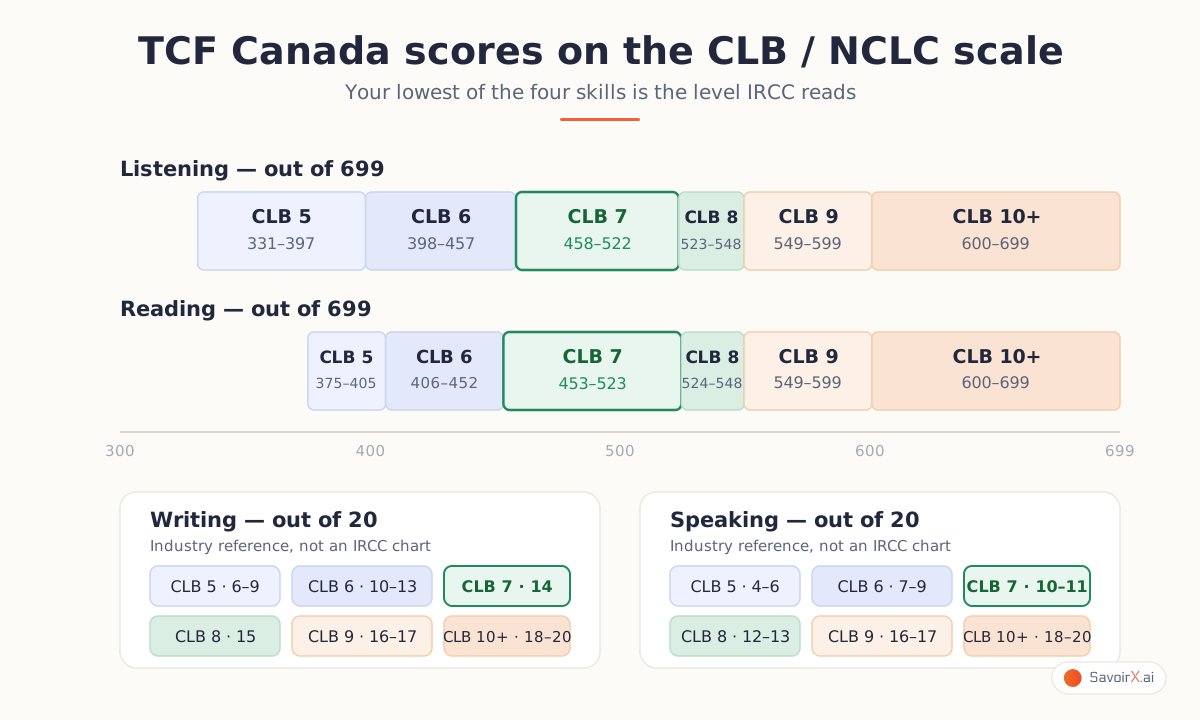
2. Official Reference Table for TCF Canada Score and CLB Level Equivalency
Once you understand the conversion mechanism, the following table serves as your authoritative reference for calculating target scores.
This table is compiled based on the publicly available TCF Canada official score ranges and widely accepted CLB equivalencies used within the exam preparation industry.
Official disclaimer. The TCF Canada Listening and Reading ranges are based on official test structure documentation. However, IRCC has not published an official, point-by-point CLB conversion chart for TCF Writing/Speaking. The ranges provided for Writing and Speaking are common industry references for preparation planning only. The final conversion is subject to the IRCC's actual assessment.
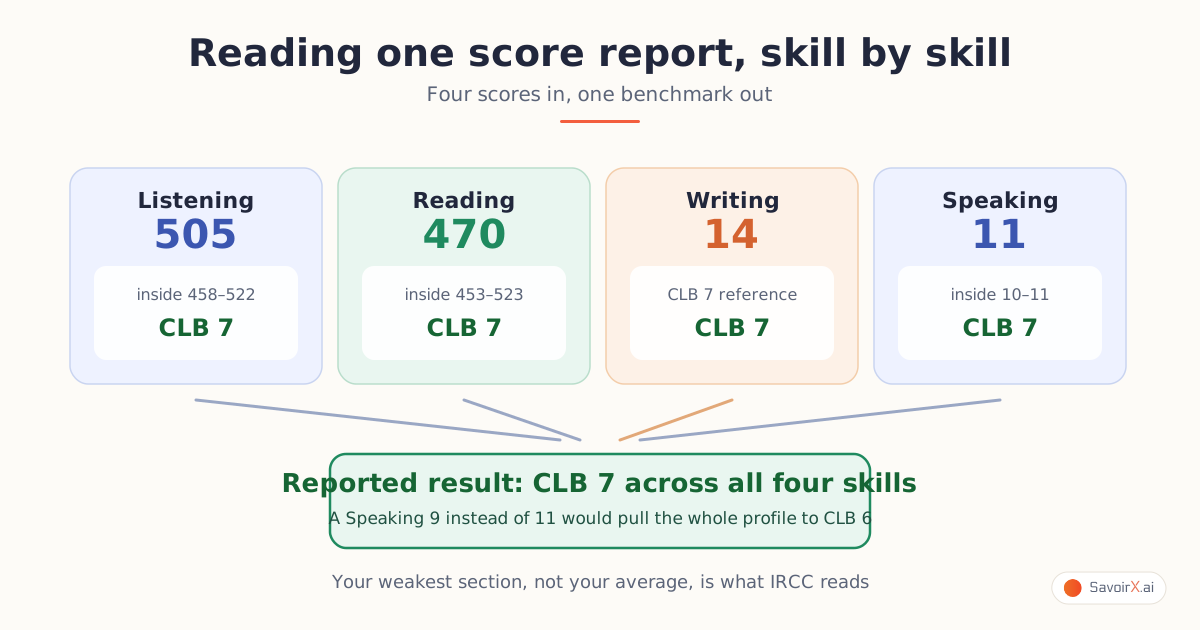
3. A Worked Example: Reading One Score Report
Reading the table in the abstract is harder than reading it against a real profile.Take a candidate who receives Listening 530, Reading 470, Writing 13, and Speaking 11.
Three of the four land above CLB 7, yet the reported result is CLB 7, because reading and speaking sit at that floor. Notice what happens if Speaking comes back as 9 instead of 11: that skill drops to CLB 6, and the whole application is assessed at CLB 6. Your weakest section, not your average, is what IRCC reads.
In summary, once you know your score targets, the next step is to understand what these CLB levels mean for your immigration application—this is the core of strategy development.
Targeting the Immigration Benchmark: How to Achieve CLB 7/8
In the Canadian Federal Express Entry system, the CLB level you achieve directly determines your CRS (Comprehensive Ranking System) score and overall competitiveness.
CLB 7: The minimum language requirement for most programs
Mainstream programs like the Federal Skilled Worker Program (FSWP) and the Canadian Experience Class (CEC) require applicants to achieve at least CLB 7 in all four abilities (TCF Canada approximately equivalent to B2 level). This is your "key to the door" to start the immigration application process.
CLB 8 or CLB 9: A powerful source of CRS points
This is the key to creating a competitive advantage. Achieving CLB 8 or CLB 9 will earn you significantly more language bonus points and additional points under the "Skill Transferability Factors," which can be decisive in whether you receive an Invitation to Apply (ITA).
To achieve these higher scores, you need a scientific and targeted preparation strategy to ensure your resources are invested precisely and efficiently.
Targeted Preparation Strategy (A2/B1/B2 Level Focus)
Utilizing level-based resources allows you to precisely plan your learning path, ensuring your ability aligns with the exam requirements. The three stages below build on each other, so read them as one path rather than three options.
After clarifying the focus for each level, the key lies in mastering specific breakthrough methods for each section, as every component must meet the standard.
Score Improvement Tips for TCF Four Sections (Practical Guide)
1) Writing (The Section That Most Often Holds Back TCF Scores)
The key to improving writing is structure and precision. Avoiding grammatical errors, expanding B2-level vocabulary, and using advanced connectors (e.g., cependant, en revanche, par conséquent) are fundamental for a high score.
High-Efficiency Tip: Use AI-powered intelligent correction. It can instantly point out grammatical errors, inappropriate vocabulary, and insufficient logical structure, providing targeted suggestions for revision. This is the fastest way to achieve a TCF Canada B2 writing score breakthrough.
2) Coordinated Improvement for Reading, Listening, Grammar, and Vocabulary
Scores in Listening and Reading are largely dependent on your vocabulary size and ability to recognize grammatical structures. The coordinated improvement of these two foundational skills will help you make more precise judgments in multiple-choice questions.
Once you master these techniques, the next step is to integrate them into your systematic training to achieve your ultimate immigration goal.
Conclusion and SavoirX Preparation Resource Recommendation
Final Review and Action Plan
Your CLB level determines your CRS language bonus points; CLB 7 is the minimum threshold, and CLB 8/9 provides a significant advantage. Scientific planning and systematic training are the guarantees of success.
Real TCF Canada tasks, scored like the exam
Months of preparation come down to a few hours in one room. Practise on TCF Canada B2 tasks until nothing on the paper can surprise you.
- 500+ practice tasksWriting, speaking, reading and listening, all in TCF Canada format.
- Topics refreshed each quarter100 expert-curated writing topics, aligned with current exam trends.
- Examiner-standard markingScored against the official grid, with your level estimated.
- Detailed feedback on every errorWhy it costs you points, plus a model rewrite to learn from.
Free to start. Cancel anytime.
Or see how SavoirX prepares you for TCF Canada