
The speaking section (expression orale) of TCF Canada is a 12-minute face-to-face interview that tests your ability to communicate in French. For many immigration applicants, this is the most anxiety-inducing part of the exam.
This guide covers exactly what to expect and how to prepare.
How the speaking test is structured
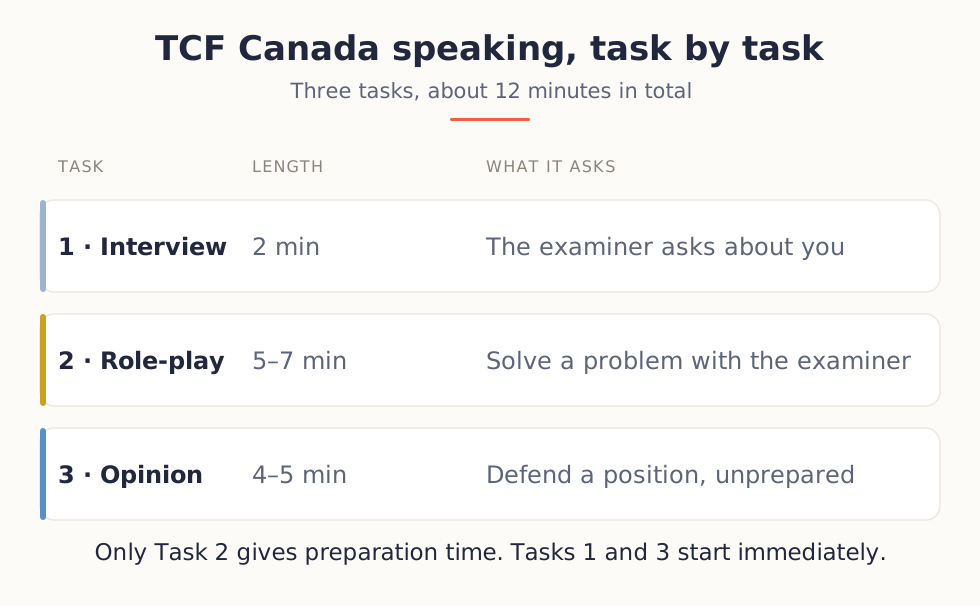
- Duration 12 minutes total
- Format Face-to-face with one examiner
- Tasks 3 tasks, increasing difficulty
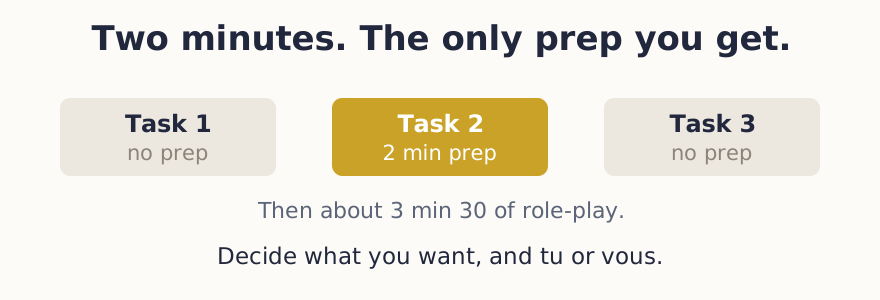
- Preparation 2 minutes for Task 2 only
Unlike DELF, TCF Canada speaking is not pass/fail. You receive a score from 0-20, which converts to a CLB level.
CLB Conversion for Speaking
Your speaking score directly affects your immigration points:
Target for Express Entry: Most candidates aim for CLB 7+ (score 10-11+) in speaking to maximize CRS points. This requires solid B2-level oral skills.
The Three Speaking Tasks
The oral runs about twelve minutes across three tasks that get harder as they go. Only the second gives you preparation time; the third expects you to start speaking the moment you have the topic.
Task 1: Personal Interview (2 minutes)
The examiner asks questions about you and your life. This is the warmup.
Task 1 focus: basic personal topics, clear sentences, and natural delivery.
Common topics
- Your background and origin
- Work or studies
- Daily life and routines
- Hobbies and interests
- Family and living situation
- Reasons for immigrating to Canada
Example questions
- Pouvez-vous vous présenter?
- Que faites-vous dans la vie?
- Pourquoi voulez-vous immigrer au Canada?
- Parlez-moi de votre famille.
- Quels sont vos loisirs?
Tips for Task 1
- Answer in complete sentences, not single words
- Develop your answers (3-4 sentences per question)
- Stay calm and natural
- Don't memorize scripts - examiners notice
Sample response
Sample Response · Task 1
Je m'appelle Marie et je suis originaire du Maroc. Je travaille comme ingénieure en informatique depuis cinq ans. J'ai décidé d'immigrer au Canada parce que je cherche de meilleures opportunités professionnelles et une meilleure qualité de vie pour ma famille.
Task 2: Interactive Role-play (5-7 minutes)
You receive a scenario and get 2 minutes to prepare, then interact with the examiner in a role-play situation for about 3 minutes 30.
Task 2 focus: problem-solving dialogue, persuasion, and appropriate register.
Types of scenarios
- Resolving a problem or complaint
- Convincing someone of something
- Negotiating a solution
- Asking for information and responding
- Making arrangements or plans
- Scenario A You booked a hotel room online, but when you arrive, the room is not what was promised. Speak to the hotel manager.
- Scenario B Your neighbor's dog barks all night. Have a conversation with your neighbor to resolve the issue.
- Scenario C You want to organize a community event. Convince the town council representative to support your project.
What the examiner evaluates
- Ability to express opinions and arguments
- Appropriate register (formal when needed)
- Ability to react to what the other person says
- Problem-solving through dialogue
Tips for Task 2
- Listen carefully to the examiner's role
- React to what they say - don't just recite prepared phrases
- Use persuasion techniques: explain reasons, offer compromises
- Stay polite even when "complaining"
- Use appropriate formality level
Useful phrases
- Je comprends votre position, mais...
- Ne pourrait-on pas trouver un compromis?
- J'apprécierais vraiment si vous pouviez...
- Permettez-moi de vous expliquer la situation.
- Que proposez-vous comme solution?
Task 3: Expressing and Defending an Opinion (4-5 minutes)
You receive a topic and start speaking right away: this task has no preparation time. You present and defend your opinion in continuous speech.
Task 3 focus: clear stance, structured argument, and calm defense.
Format
- Topic given on the spot, with no preparation time
- Monologue about 4 minutes 30 of continuous speech presenting and defending your view
- Structure on the fly position, arguments with examples, concession, conclusion
Common topic themes
- Technology and society
- Environment and sustainability
- Work-life balance
- Education and learning
- Urban vs. rural life
- Social media and communication
- Health and lifestyle
Example topics
- "Les réseaux sociaux ont plus d'inconvénients que d'avantages." Qu'en pensez-vous?
- "Le télétravail devrait devenir la norme." Êtes-vous d'accord?
- "L'apprentissage en ligne peut remplacer l'enseignement traditionnel." Donnez votre opinion.
Structure for your monologue
- Introduction (about 30 seconds)Acknowledge the topic and state your position clearly
- Arguments (about 3 minutes)Present 2-3 main points with examples and connectors
- Concession and conclusion (about 1 minute)Acknowledge the other side, then summarize your position
Tips for Task 3
- There is no preparation time - train yourself to structure as you speak
- Don't try to memorize - lean on a reusable structure instead
- Address the opposing view yourself with a concession, since no one will prompt you
- Keep talking: sustaining the full duration matters as much as the content
- Use opinion expressions naturally
Key phrases
- À mon avis, ... / Selon moi, ...
- Je suis convaincu(e) que...
- Il est indéniable que...
- Certes, ... mais je pense que...
- En ce qui concerne...
- Pour conclure, je dirais que...
How it is scored
Examiners score you on five main dimensions:
1. Completion of Tasks
- Following instructions correctly
- Addressing all parts of each task
- Staying relevant to the topic
2. Interaction and Fluency
- Responding appropriately to the examiner
- Maintaining conversation flow
- Speaking without excessive hesitation
- Self-correcting smoothly
3. Vocabulary Range
- Range and variety of words
- Precision in word choice
- Ability to paraphrase when needed
- Topic-appropriate vocabulary
4. Grammar and Structures
- Correct tense usage
- Proper agreement (gender, number)
- Sentence complexity appropriate to level
- Accuracy in common structures
5. Pronunciation and Intonation
- Clear pronunciation of sounds
- Natural rhythm and stress patterns
- Appropriate intonation for questions and statements
- Overall intelligibility
Target Scores for Immigration
For most Express Entry applicants:
Strategy tip: If speaking is your weakest skill, focus preparation there. Each skill is scored independently - a strong writing score can't compensate for weak speaking.
How to prepare
- Describe your day in French
- Express opinions on news topics
- Practice answering common questions
- Record yourself and listen back
- Take turns being examiner and candidate
- Use real TCF topics and scenarios
- Time each section accurately
- Give feedback on strengths and weaknesses
- Taking a position on controversial topics
- Structuring arguments with introduction-body-conclusion
- Defending your position when challenged
- Acknowledging counterarguments gracefully
- Je pense que... / Je crois que...
- Il me semble que...
- Je suis persuadé(e) que...
- D'une part... d'autre part
- De plus, / En outre,
- Cependant, / Néanmoins,
- Par exemple, ...
- Prenons le cas de...
- On peut citer...
- Certes, ... mais...
- Il est vrai que... cependant...
- Même si..., je maintiens que...
Common Mistakes to Avoid
During Task 1
- Giving one-word or very short answers
- Sounding rehearsed or robotic
- Not developing responses with details
During Task 2
- Ignoring what the examiner says
- Being too aggressive in "complaint" scenarios
- Not adapting to the situation as it develops
- Forgetting to use polite forms
During Task 3
- Not using the preparation time effectively
- Having no clear structure to your argument
- Speaking too briefly (under 2 minutes)
- Panicking when the examiner disagrees
Practice Topics
Use these for Task 3 practice:
- Les voitures électriques devraient être obligatoires d'ici 2030.
- Le travail à distance est meilleur que le travail au bureau.
- Les réseaux sociaux nuisent aux relations humaines.
- L'intelligence artificielle va remplacer de nombreux emplois.
- Vivre en ville est préférable à vivre à la campagne.
- L'éducation universitaire ne garantit plus le succès professionnel.
- Les parents devraient limiter le temps d'écran de leurs enfants.
- Le tourisme de masse détruit les sites qu'il prétend célébrer.
Related Articles
Practice With an AI Examiner
Finding a partner who can play a convincing TCF examiner is hard, and tutor sessions are expensive to repeat several times a week. SavoirX now includes a full TCF Canada mock speaking test you can sit online, as many times as you want.
The simulation runs all three tasks in the official format and timing: the guided interview, the interactive role-play (with the 2-minute preparation window before Task 2), and the opinion monologue. The AI examiner asks its questions aloud with natural French intonation and adapts its follow-ups to what you actually say, so no two sessions play out the same way.
When you finish, you get a score on the official rubric with a CEFR level estimate, corrections of your mistakes, and fluency metrics, plus the full transcript and audio of your session so you can hear exactly where you hesitated.
Speaking vs. Writing: Different Skills
Some candidates are surprised that their speaking score differs from writing. This is normal:
If your speaking is weaker:
- Practice out loud more often
- Work on thinking in French (not translating)
- Focus on fluency over accuracy
- Get comfortable with being "put on the spot"
Day-of-Exam Tips
Before the speaking test:
- Warm up your voice (speak some French aloud)
- Review your key phrases
- Take deep breaths to calm nerves
- Remember: the examiner wants you to succeed
During the test:
- Greet the examiner politely
- Speak clearly and at a steady pace (not too fast)
- Make eye contact
- If you don't understand, ask: Pouvez-vous répéter, s'il vous plaît?
- If you make a mistake, correct it briefly and continue
Mental strategies:
- Treat it as a conversation, not an interrogation
- It's okay to pause and think
- Don't aim for perfection - aim for clear communication
- Small errors won't fail you if communication is good