
Writing Task 2 is a key task in the TCF Canada writing section. Unlike Task 3 which focuses on argumentation, Task 2 primarily assesses your ability to narrate a personal experience or observation while expressing your feelings and opinions. The task usually asks you to describe an event, share an experience, or recount something meaningful to you, then add your personal reflections and suggestions. The required length is 120–150 words, and it is recommended to complete it within 20 minutes. If you haven't mastered Task 1 yet, we recommend starting there first.
- Task type Personal narrative / experience + opinion
- Word count 120-150 words
- Recommended time 20 minutes
- Main focus Clear narration, authentic feeling, a stated opinion
Time allocation: It is recommended to dedicate 20 minutes to Task 2. For this task, you need a clear narrative structure, authentic emotional expression, and natural, flowing language.
Task Requirements
This task generally requires you to describe an event, narrate an experience, or share something that happened to you, while adding your personal comments, opinions, or suggestions. Themes are usually related to real-life situations such as learning experiences, travel experiences, cultural discoveries, or social phenomena.
You must:
- Clearly explain the context and purpose explain why you are writing (to share an experience, express an opinion, give advice, persuade readers, etc.).
- Organize your content narrate events chronologically or group ideas by topic, making the text structured and easy to read.
- Express personal feelings and opinions include emotions, evaluations, or reflections alongside the facts, and use connectors to ensure coherence.
- Produce a complete structure include an engaging introduction, a well-developed body describing the experience, and a conclusion with a summary, opinion, or suggestion. Avoid writing a simple list of events or a text that lacks purpose.
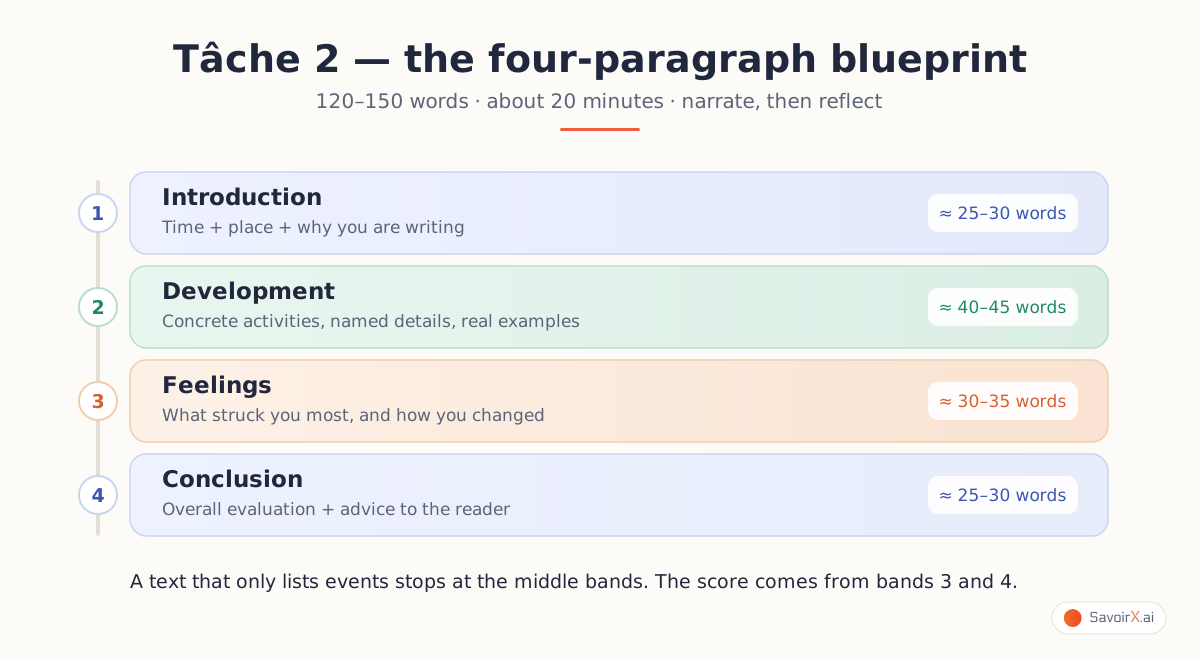
The four requirements above map onto four paragraphs. Before looking at any sample text, it helps to see how the word budget spreads across them.
Scoring Criteria
Scoring mainly focuses on four aspects:
- Task completion (5 points)
- Does your answer stay on topic?
- Is your position clear, or does your text present a complete advantages-and-disadvantages analysis?
- Do you provide sufficient reasons and examples?
- Structure and coherence (5 points)
- Does your text follow the structure “introduction – body – conclusion”?
- Do you use logical connectors (e.g., tout d’abord, ensuite, cependant, en conclusion)?
- Language accuracy (5 points)
- Are your verb tenses and grammar correct?
- Are there few or almost no spelling mistakes?
- Richness of expression (5 points)
- Do you use varied vocabulary and structures?
- Do you include advanced expressions (e.g., même si…, ce qui…, à condition que…)?
Task Types and Examples
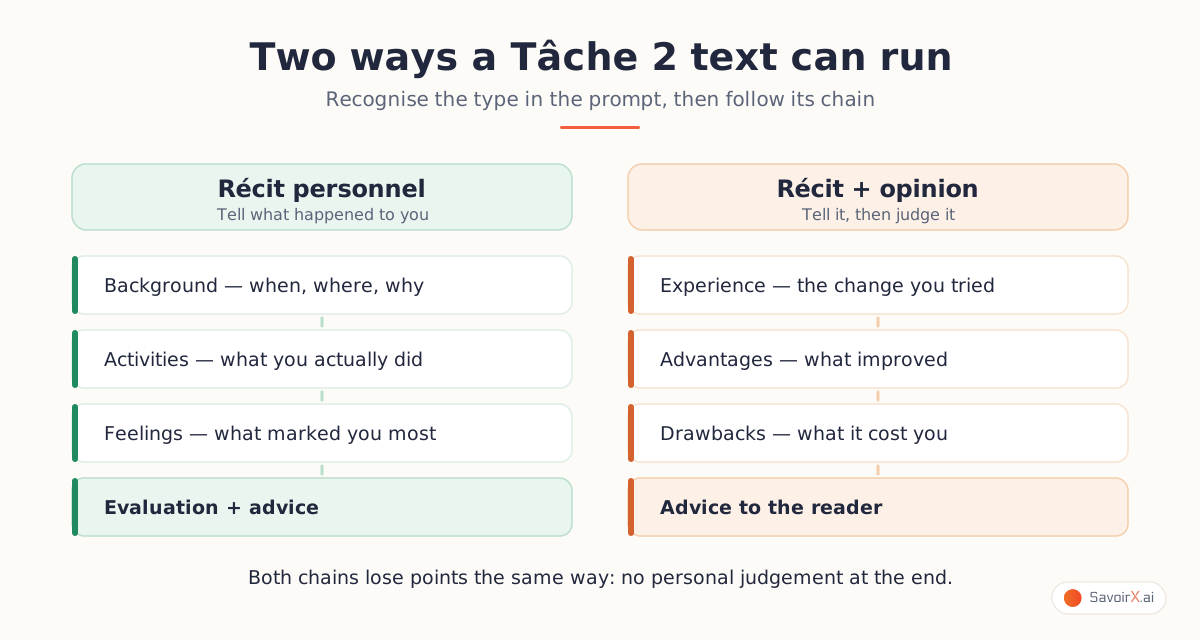
In TCF Canada Writing Task 2, candidates need to write a 120–150-word essay, expressing experiences, opinions, or suggestions according to the instructions. Although the official prompts vary, based on scoring criteria and patterns from past exams, Task 2 can actually be divided into two main writing types:
- Narrative type (Récit personnel / Témoignage) Focuses on recounting a personal experience, learning journey, cultural activity, or daily event, while sharing your feelings and insights.
- Experience + Opinion type (Récit + Opinion / Billet d’opinion) Begins with a personal experience or observation and then provides an evaluation, reflection, or suggestion. Common in blog-style topics, healthy-living themes, and practical advice writing.
Master these two structures, and you can handle nearly all Task 2 prompts. Below are two high-scoring sample texts to show how each type works.
Category 1: Narrative Type (Récit personnel / Témoignage)
One of the core writing types you must master in TCF Canada Task 2 is the narrative type. These prompts typically require you to recount a personal experience, such as a trip, a learning process, a cultural activity, or a memorable daily event. By describing time, place, people, and emotions, this type of essay shows whether you can clearly express events, structure paragraphs, and convey feelings. To help you understand this format, let’s begin with a complete example to see how a standard narrative text is developed.
Example: Studying in Canada (Séjour linguistique au Canada)
Task Requirement
En français Vous écrivez un article pour le blog de votre école de langue. Vous racontez votre expérience après avoir passé trois mois dans une université canadienne. Décrivez les moments les plus marquants de votre séjour, expliquez ce que cette expérience vous a apporté et donnez quelques conseils aux futurs étudiants.
English Explanation You are writing an article for your language school’s blog, describing your three-month study experience at a Canadian university. Describe the most memorable moments, explain what you gained from this experience, and give some advice to future students.
Sample Essay
Il y a quelques mois, j’ai eu l’occasion de passer trois mois dans une université canadienne pour améliorer mon français. Dès mon arrivée à Montréal, j’ai été impressionné par l’accueil chaleureux des étudiants locaux et par la diversité culturelle de la ville.
Pendant les premières semaines, j’ai participé à plusieurs activités organisées par l’université : visites de musées, soirées internationales et groupes de conversation. Ces moments m’ont beaucoup aidé à progresser et à mieux comprendre la culture du pays.
Ce qui m’a le plus marqué, c’est la manière dont les professeurs encourageaient chacun à s’exprimer. Grâce à leurs conseils, j’ai gagné en confiance et j’ai beaucoup amélioré mon oral.
En conclusion, ce séjour a été une expérience inoubliable. Je recommande vivement à tous les étudiants de tenter une telle aventure : elle permet non seulement de progresser en langue, mais aussi de s’ouvrir au monde.
Paragraph-by-Paragraph Analysis
Read the sample once more, this time one paragraph at a time. Each block below pairs the French text with the structures that earn the marks.
Paragraph 1: Introduction (Background)
Il y a quelques mois, j'ai eu l'occasion de passer trois mois dans une université canadienne pour améliorer mon français. Dès mon arrivée à Montréal, j'ai été impressionné par l'accueil chaleureux des étudiants locaux et par la diversité culturelle de la ville.
This opening paragraph establishes the background quickly. Key grammar points include: Il y a + duration (a few months ago), j'ai eu l'occasion de + infinitive (had the opportunity to), and Dès mon arrivée (as soon as I arrived). Useful expressions to note: accueil chaleureux, diversité culturelle.
Paragraph 2: Development (Activities & Experience)
Pendant les premières semaines, j'ai participé à plusieurs activités organisées par l'université : visites de musées, soirées internationales et groupes de conversation. Ces moments m'ont beaucoup aidé à progresser et à mieux comprendre la culture du pays.
This paragraph provides concrete examples and shows personal growth. Notice the time marker Pendant + duration, the structure participer à + activity, and the listing format (A, B et C) which adds richness. The phrase aider quelqu'un à + infinitive shows what you gained from the experience.
Paragraph 3: Feelings & Personal Growth
Ce qui m'a le plus marqué, c'est la manière dont les professeurs encourageaient chacun à s'exprimer. Grâce à leurs conseils, j'ai gagné en confiance et j'ai beaucoup amélioré mon oral.
This paragraph transitions from events to emotions. The structure Ce qui m'a le plus marqué, c'est… is excellent for highlighting key impressions. Notice the use of imparfait (encourageaient) for habitual actions, and Grâce à + noun to show positive cause-and-effect. Key expressions: gagner en confiance, améliorer mon oral.
Paragraph 4: Conclusion (Evaluation + Advice)
En conclusion, ce séjour a été une expérience inoubliable. Je recommande vivement à tous les étudiants de tenter une telle aventure : elle permet non seulement de progresser en langue, mais aussi de s'ouvrir au monde.
The conclusion wraps up with evaluation and advice. En conclusion clearly signals the ending, while recommander à quelqu'un de + infinitive is perfect for giving suggestions. The structure non seulement… mais aussi… adds sophistication. Key expressions: tenter une telle aventure, s'ouvrir au monde.
Time Management (20-Minute Version)
Twenty minutes sounds tight, but only half of it is spent writing. Here is how the rest is best used:
Writing Tips Summary
- The introduction must clearly state backgroundtime + place + purpose.
- Use chronological connectorsDès mon arrivée, Pendant les premières semaines.
- Include feelings and personal insightsCe qui m’a le plus marqué…
- Be as specific as possiblewrite concrete activities (musées, soirées internationales, groupes de conversation).
- Conclusion must include evaluation or adviceJe recommande vivement… for a complete and purposeful ending.
TCF Canada Task 2 — Universal Template for Experience + Comment Writing
Strip the Canada example away and the same skeleton is left. Fill these slots with your own content and the structure takes care of itself.
1. Introduction (2–3 sentences)
- Present time + background + action
- Il y a quelques mois, j’ai décidé de changer mes habitudes…
- J’ai commencé une nouvelle routine pour…
- Introduce the cause of the experience or your initial feeling
- Au début, c’était simplement un test…
- Très vite, j’ai remarqué que…
2. Body (2 paragraphs, 2–3 sentences each)
(1) Experience / Change (describe what you did)
- Explain the actions you took or what you tried
- Pendant les premières semaines, j’ai essayé de…
- J’ai commencé par… puis j’ai continué à…
- Describe the changes or observations
- J’ai rapidement constaté que…
- Cette nouvelle habitude m’a permis de…
(2) Comment / Evaluation (advantages + limitations)
- Write about the advantages or positive effects
- Grâce à cette expérience, je me sentais…
- Cela m’a aidé à améliorer…
- Point out limitations or things to keep in mind
- Cependant, j’ai aussi remarqué que…
- Malgré cela, je pense que…
3. Conclusion (2 sentences)
- Give an overall evaluation
- En conclusion, cette expérience a été vraiment bénéfique.
- Elle m’a permis de mieux comprendre…
- Give advice to the reader (aligned with the prompt)
- Je recommande à chacun d’essayer au moins pendant quelques semaines.
- C’est une bonne façon de trouver un équilibre plus sain.
Through this example, you can see that the key to narrative-style writing is to clearly explain “what happened” and “what it meant to me.” As long as you master the basic structure—background, experience, feelings, and conclusion—plus some concrete details and natural emotional expression, you can write a text that meets the scoring criteria and reads smoothly and authentically.
Category 2: Experience + Comment (Récit + Opinion / Billet d'opinion) – Example
After understanding the logic of narrative-type prompts, we can go further and explore another common type: the combination of experience and commentary, which places more emphasis on opinion and evaluation. In addition to simply recounting an experience, TCF Canada Task 2 often asks you to add your personal viewpoint and evaluation on top of the narrative. This type of prompt asks you to describe a small experience or observation, analyze its meaning and impact, and give advice to the reader. Therefore, it is more “thought-based” than a simple narrative and better reflects your language skills.
Example: Healthy Lifestyle (Changer mes habitudes alimentaires)
Task Requirement
En français Vous écrivez un billet d’opinion pour un blog dédié au bien-être. Vous racontez une expérience personnelle liée à votre alimentation (un changement, une habitude nouvelle, un essai du bio…) puis vous donnez votre avis sur son efficacité, en expliquant pourquoi et en donnant un conseil à vos lecteurs.
English Explanation You need to write an opinion piece for a wellness blog. First, describe a personal experience related to your diet (for example, trying organic food or changing your eating habits), then give your evaluation of this approach and offer some advice to your readers.
Sample Essay (Experience + Comment type, about 150 words)
Il y a quelques mois, j’ai décidé de changer mes habitudes alimentaires en achetant uniquement des produits bio. Au début, ce n’était qu’un simple test, mais très vite j’ai remarqué quelques différences dans mon quotidien.
Grâce à cette nouvelle routine, je me sentais moins fatigué et j’avais l’impression de manger plus naturellement. Cependant, j’ai aussi constaté que le coût était plus élevé, ce qui n’est pas toujours facile à gérer pour un étudiant. Malgré cela, je pense que cette expérience a été vraiment bénéfique pour ma santé.
En conclusion, je recommande aux lecteurs d’essayer au moins pendant quelques semaines. Cela permet de mieux comprendre son corps et de trouver un équilibre plus sain, même si chacun doit adapter cette pratique à son budget.
Paragraph Analysis + Grammar & Useful Expressions
The same three-part reading applies here: what the writer did, how they judged it, and what they told the reader to do.
Paragraph 1: Introduction (Background of the experience)
Il y a quelques mois, j’ai décidé de changer mes habitudes alimentaires en achetant uniquement des produits bio. Au début, ce n’était qu’un simple test, mais très vite j’ai remarqué quelques différences dans mon quotidien.
Grammar Highlights
- Il y a + duration: expresses “... ago”, suitable for narrating experiences.
- j’ai décidé de + infinitive: expresses a deliberate decision, more explicit than j’ai commencé à…
- changer mes habitudes alimentaires: set phrase meaning “to change my eating habits.”
- Au début… très vite…: shows the progression of time and change.
- remarquer que…: commonly used to describe observations and results.
Useful Expressions
- habitudes alimentaires
- simple test
- remarquer des différences
Function
- Clearly states the time frame and motivation, quickly establishing the narrative context and naturally leading into the description of the experience.
Paragraph 2: Comment (Advantages + Drawbacks)
Grâce à cette nouvelle routine, je me sentais moins fatigué et j’avais l’impression de manger plus naturellement. Cependant, j’ai aussi constaté que le coût était plus élevé, ce qui n’est pas toujours facile à gérer pour un étudiant. Malgré cela, je pense que cette expérience a été vraiment bénéfique pour ma santé.
Grammar Highlights
- Grâce à…: positive cause-and-effect connector.
- se sentir + adj.: expresses physical or emotional change.
- avoir l’impression de…: commonly used structure for subjective impressions.
- Cependant…: classic contrast connector introducing drawbacks.
- je pense que / je trouve que…: standard patterns for expressing personal evaluation.
Useful Expressions
- manger naturellement
- constater que…
- coût élevé
- expérience bénéfique
Function
- Shows a complete reasoning chain: “advantages → drawbacks → overall evaluation,” which fits the requirements of a comment-style text.
Paragraph 3: Conclusion (Advice)
En conclusion, je recommande aux lecteurs d’essayer au moins pendant quelques semaines. Cela permet de mieux comprendre son corps et de trouver un équilibre plus sain, même si chacun doit adapter cette pratique à son budget.
Grammar Highlights
- recommander à qn de + infinitive formal pattern for giving advice.
- au moins pendant quelques semaines provides specific, realistic advice.
- Cela permet de… explains the reason behind the suggestion.
- même si… acknowledges limitations, making the text more balanced and objective.
Useful Expressions
- trouver un équilibre plus sain
- adapter une pratique à son budget
Function
- Fulfills the purpose of the text: giving advice and encouraging action, while remaining realistic and flexible.
Writing Time Management (20-Minute Version)
The clock works the same way as for the narrative type, only the outline step changes shape:
Writing Tips Summary
- The introduction must include “time + action + background” to quickly establish context.
- Make the experience paragraph as concrete as possible (what changed? why?).
- The comment paragraph must include both advantages and drawbacks to show a mature perspective.
- Use emotional and sensory expressionsje me sentais… / j’ai constaté…
- The conclusion must give advice to the readerthis matches the “opinion / billet d’opinion” nature of the task.
TCF Canada Task 2 — Universal Template for Experience + Comment (Récit + Opinion)
Here is the same skeleton adapted to the opinion variant, with the judgement built into the body rather than saved for the end.
1. Introduction (2–3 sentences)
- Present “time + action + motivation”
- Il y a quelques mois, j’ai décidé de…
- J’ai commencé à… pour…
- Briefly state that this was a trial/change
- Au début, c’était simplement un test…
- Je voulais voir si cela pouvait vraiment m’aider…
Function: Establishes the background of the experience and sets up the later commentary.
2. Body (2 paragraphs, 2–3 sentences each)
(1) Results of the experience + Changes (Advantages)
- Explain the positive effects
- Grâce à cette nouvelle habitude, je me sentais…
- J’ai remarqué que… / J’ai constaté que…
- Express physical or emotional change
- Je me sentais moins… / plus…
(2) Comment (Drawbacks + Overall Evaluation)
- Introduce drawbacks
- Cependant, j’ai aussi remarqué que…
- Malheureusement, il y avait également…
- Give an overall evaluation
- Malgré cela, je pense que cette expérience a été vraiment bénéfique.
- Au final, je trouve que ce changement m’a beaucoup apporté.
Function: Covers both advantages and drawbacks, showing “reflection + judgment.”
3. Conclusion (2 sentences)
- Give advice
- En conclusion, je recommande d’essayer au moins pendant quelques semaines.
- C’est une bonne manière de comprendre ce qui vous convient vraiment.
- Acknowledge individual differences and remain objective
- Même si chacun doit adapter cette pratique à sa situation.
- Il est important de trouver son propre équilibre.
From this example and template, we can see that the key to the experience + comment type is “first narrate, then evaluate, and finally advise.” As long as your logic is clear and your opinion is well expressed, you can get a good score. Once you understand this structure, you can handle a wide range of everyday or social topics in the exam. Next, you can move on to more advanced writing techniques and high-scoring sentence patterns.
TCF Canada Task 2 — Common Topics + High-Scoring Expressions
After reviewing the specific task types and examples, let’s summarize the most frequent topic categories in the exam. By mastering these high-scoring expressions related to common themes, you will be able to quickly organize your ideas and produce more convincing writing in the exam.
1. Food & Health
Common topics (rewritten in authentic TCF Canada style):
- Vous racontez un changement récent dans vos habitudes alimentaires et expliquez ses effets sur votre santé.
- Vous décrivez une activité sportive que vous avez commencée et donnez votre avis sur son utilité.
Useful expressions
- occupe une place centrale → plays a central role
- contribuer à une meilleure santé → contributes to better health
- à long terme → in the long term
- alimentation équilibrée → balanced diet
- réduire les risques de maladies → reduce the risk of diseases
2. Technology & Daily Life
Common topics (following real TCF writing style):
- Vous racontez une expérience récente d’achat en ligne et expliquez pourquoi vous la recommandez ou non.
- Vous décrivez votre utilisation quotidienne des réseaux sociaux et donnez votre avis sur leurs effets.
Useful expressions
- offrir une grande commodité → offer great convenience
- comporter certains risques → involve certain risks
- faciliter la communication → facilitate communication
- entraîner une dépendance → lead to dependency
- perte de confiance → loss of trust
3. Environmental Protection
Common topics (based on official TCF corpus):
- Vous expliquez un geste écologique que vous avez adopté et décrivez ses avantages.
- Vous racontez comment vous limitez l’usage de la voiture et donnez des conseils à vos lecteurs.
Useful expressions
- protéger l’environnement → protect the environment
- préserver la biodiversité → preserve biodiversity
- réduire la pollution → reduce pollution
- mode de vie durable → sustainable lifestyle
- respecter davantage la nature → respect nature more
4. Education & Work
Common topics (often récit + opinion format in Task 2):
- Vous racontez une expérience d’étude à l’étranger et expliquez ce qu’elle vous a apporté.
- Vous décrivez une période de télétravail et donnez votre opinion sur ses avantages et ses limites.
Useful expressions
- offrir de meilleures opportunités → offer better opportunities
- développer des compétences → develop skills
- favoriser l’autonomie → promote autonomy
- rencontrer des difficultés → encounter difficulties
- équilibre entre vie professionnelle et vie privée → work-life balance
5. Society & Culture
Common topics (realistic TCF writing style):
- Vous racontez une expérience de bénévolat et expliquez pourquoi elle a été importante pour vous.
- Vous décrivez comment la lecture a influencé votre enfance et donnez un avis personnel.
Useful expressions
- renforcer les liens sociaux → strengthen social bonds
- favoriser l’intégration → promote integration
- transmettre des valeurs → transmit values
- enrichir ses connaissances → enrich one’s knowledge
- jouer un rôle essentiel → play an essential role
By learning and memorizing these thematic vocabulary groups, you will handle the writing exam much more smoothly!
Summary
In conclusion, although the themes of Task 2 are diverse, the writing approach is highly consistent:
- Start with a brief introduction that sets the context for your experience
- Develop the body by describing what happened, how you felt, and what you learned
- Conclude with your personal reflection, a recommendation, or advice to readers
Task 2 is fundamentally about storytelling with insight. As long as you can narrate clearly, express authentic emotions, and share meaningful reflections, you will score well. Master these common topic areas and memorize some useful expressions, and you'll be able to respond confidently during the exam. Ready for the final challenge? Move on to our Task 3 guide to master summary and argumentation.
Real TCF Canada tasks, scored like the exam
Months of preparation come down to a few hours in one room. Practise on TCF Canada B1-B2 tasks until nothing on the paper can surprise you.
- 260+ writing tasksBuilt by our content team to the official TCF Canada format and marking criteria.
- Topics refreshed each quarter100 expert-curated writing topics, aligned with current exam trends.
- Examiner-standard markingScored against the official grid, with your level estimated.
- Detailed feedback on every errorWhy it costs you points, plus a model rewrite to learn from.
Free to start. Cancel anytime.
Or see how SavoirX prepares you for TCF Canada