
Many candidates remain stuck in a B1 writing mode for TCF Task B (usually a 300-350 word argumentative essay). The reason is consistent: B1 can state an opinion, but B2 must justify it with structure, nuance, and controlled language.
To help you move from "listing ideas" to real B2 argumentation, this guide gives you a complete operational framework: exam standards, five-paragraph logic, grammar targets, and advanced scoring strategies.
The progression is intentional: first you clarify what is evaluated, then you lock a structure, then you reinforce language tools, and finally you optimize execution under exam timing.
I. TCF B2 Writing: Core Requirements and Standards
Before looking at paragraph design, it is useful to define what the examiner expects at B2 level. Once these criteria are clear, your writing choices become much easier to control.
Structure: Clear argumentative architecture with layered progression
Depth: Ability to discuss abstract social themes with nuance
Language: Consistent use of precise connectors and advanced grammar
In other words, B2 is not about writing longer. It is about writing in a way that is logically stronger and linguistically more controlled.
With this scoring baseline in mind, we can now move to the part that has the biggest impact under time pressure: paragraph architecture.
II. TCF B2 Argumentative Essay: The Standard Five-Paragraph Structure
Now that the standard is clear, the next step is to apply a stable structure you can reproduce under exam pressure.
In practical terms, this structure is your safety rail: it helps you keep relevance, prevents idea repetition, and ensures each paragraph has a distinct role.
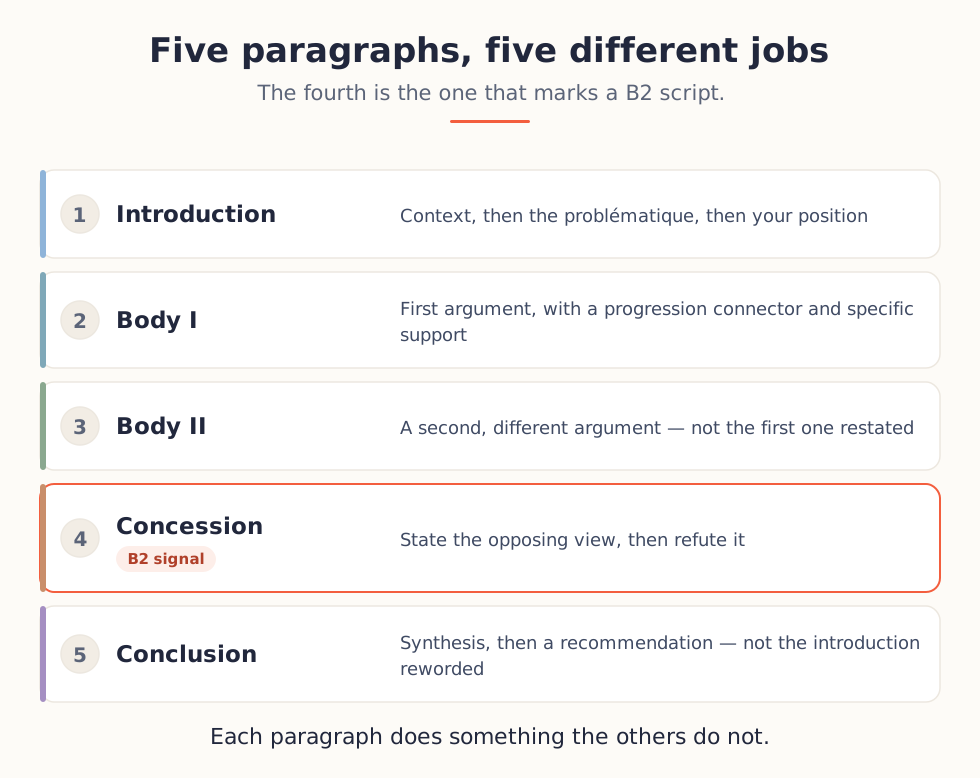
Exam reminder: The framework is not decorative. It is what keeps your logic visible and your score stable.
Once your structure is stable, the next scoring lever is language quality. That is exactly where grammar choices start to separate a basic B2 script from a stronger one.
III. TCF B2 High-Scoring Grammar Components
With the structure fixed, grammar becomes the lever that pushes your essay from "clear" to "high-level clear."
At this stage, the goal is not to display rare grammar for style alone. The goal is to choose forms that directly improve argument precision and scoring consistency.
1) The Subjunctive Mood (Le Subjonctif)
The Subjunctive is essential for necessity, doubt, desire, and evaluation, all of which appear frequently in B2 argumentation.
After Subjonctif, the natural complement is Conditionnel, because these two moods often work together in B2 essays: one for stance and evaluation, the other for hypothesis and recommendation.
2) The Conditional Mood (Le Conditionnel)
The Conditional adds rigor and nuance when proposing hypotheses or recommendations.
Once these two grammatical pillars are in place, the final layer is connective logic. This is what makes your argument read as one continuous line instead of separate blocks.
3) Advanced Connectors for Logical Flow
At B2 level, connectors should show relationship precision, not just sentence linking.
At this point, you have the core language toolkit. The next step is strategic refinement: sounding more objective, denser, and more balanced in argumentation.
IV. TCF B2 Advanced Strategies for Higher Scores
Once structure and grammar are in place, the final jump comes from style control and argumentative sophistication.
This is also where many scripts separate: two candidates may have similar ideas, but the one with stronger objectivity and tighter sentence engineering usually reads as clearly higher level.
1) Use Impersonal Structures (La Tournure Impersonnelle)
Impersonal patterns reduce repetitive "Je pense que" and make your reasoning sound more objective.
2) Complicate Relative Clauses (Les Subordonnées Relatives)
Relative structures like dont, auquel, à laquelle improve density and reduce repetition.
B2 expression: J'ai vu ce film dont j'ai beaucoup aimé les acteurs.
After concision and sentence density, the final high-impact move is argumentative balance, which is exactly why concession matters in B2 scoring.
3) Master Concession (La Concession Parfaite)
Concession must show both recognition of opposition and control of counter-argument.
Conclusion: Systematic Practice for TCF B2 Success
At this point, you have the complete B2 writing toolkit: a stable five-paragraph structure, mandatory high-value grammar (Subjonctif + Conditionnel), and advanced strategies that raise argumentative quality.
This guide also supports your broader B1 to B2 transition. For DELF-focused writing formats, continue with essay writing and formal letter tasks.
To make this framework useful on exam day, the key is repetition under constraints: same structure, same timing, same revision routine.
So the final objective is operational, not theoretical: you should be able to reproduce this logic quickly, even when the topic changes and time pressure increases.
Move from theory to production: regular timed practice is what turns this framework into stable B2 output.
Practice With Interactive Quizzes
To turn theory into score improvement, train each grammar block directly:
If you use these drills as short daily blocks, they naturally reinforce the exact structures highlighted above, which makes your next full essay attempt more fluid and more controlled.
Master Subjonctif Présent for B2 writing Start Quiz
Practice Subjonctif Passé for advanced expressions Start Quiz
Test cause-and-consequence connectors Start Quiz