
You took your French exam, got your score report, and now need to decide what that score actually means for your next step. At this stage, many candidates do not have a language problem. They have an interpretation problem.
This guide gives you a clear reading path for TCF Canada, TEF Canada, and DELF/DALF reports, then connects those results to practical decisions: submit now, improve one skill, or retake strategically.
TCF Canada: Read Your Score Report Step by Step
To start with, it helps to read TCF in two layers: report fields first, then score conversion logic. Once these two layers are clear, most confusion disappears quickly.
1) What Appears on Your TCF Report
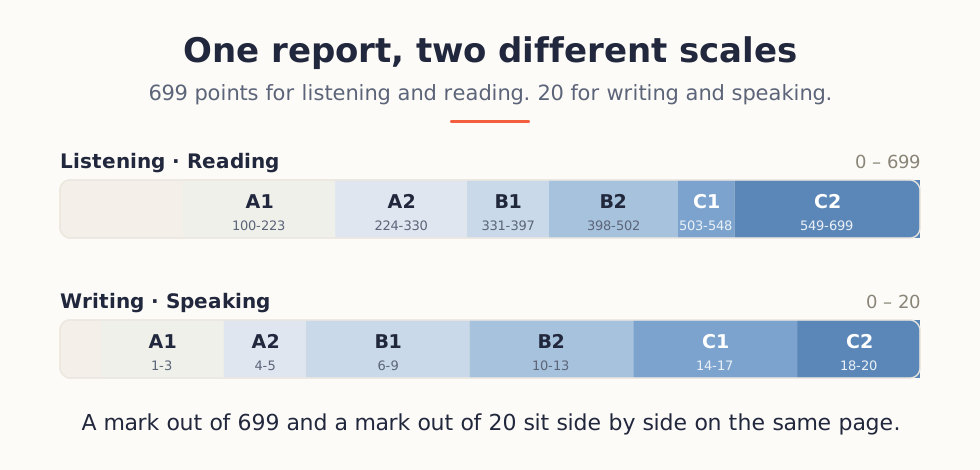
2) How TCF Score Ranges Work
Before conversion, keep one key distinction in mind: listening/reading use a 699-point scale, while writing/speaking use a 20-point scale.
3) Convert TCF Scores to CLB
Now we move from exam reading to immigration usage. If your goal is Canadian immigration, this is the section that matters most.
Important: IRCC evaluates each skill separately. For Express Entry, CLB 7+ across all four skills is typically the key threshold for stronger points.
TEF Canada: Decode Your Report Without Guesswork
With TCF logic established, TEF becomes easier to decode. The framework is similar, but score intervals are different and must be read precisely.
1) What Appears on Your TEF Report
2) How TEF Score Ranges Work
TEF Canada does not use one scale for everything. Speaking and writing are each marked out of 450, listening out of 360 and reading out of 300, so the same number means a different level depending on which skill it sits under. Newer certificates also print a harmonised /699 column — that one is not what IRCC reads.
| NCLC / CLB | Listening (/360) | Reading (/300) | Writing (/450) | Speaking (/450) |
|---|---|---|---|---|
| 10 | 316–360 | 263–300 | 393–450 | 393–450 |
| 9 | 298–315 | 248–262 | 371–392 | 371–392 |
| 8 | 280–297 | 233–247 | 349–370 | 349–370 |
| 7 | 249–279 | 207–232 | 310–348 | 310–348 |
Enter the right column. IRCC reads the Équivalence ancien score column on your certificate, not the /699 column. They are different numbers for the same test, and entering the /699 figures in an Express Entry profile can get the application refused. IRCC also reads each skill on its own — your lowest skill sets the level you can claim, and nothing is averaged.
3) Convert TEF Scores to CLB
At this point, the interpretation method is the same as TCF: match each skill score to the official IRCC CLB line.
DELF/DALF: Understand Diploma Scoring and Pass Logic
After TCF and TEF, DELF/DALF introduces a different logic. You are no longer reading a temporary attestation score. You are reading a diploma result.
1) What Appears on a DELF/DALF Report
2) How DELF/DALF Scoring Is Calculated
Because each skill has equal weight, this format is straightforward and strict.
3) Exact Passing Requirements
To pass and receive the diploma, both conditions are required:
- Minimum per section: 5/25 in each skill
- Minimum total: 50/100
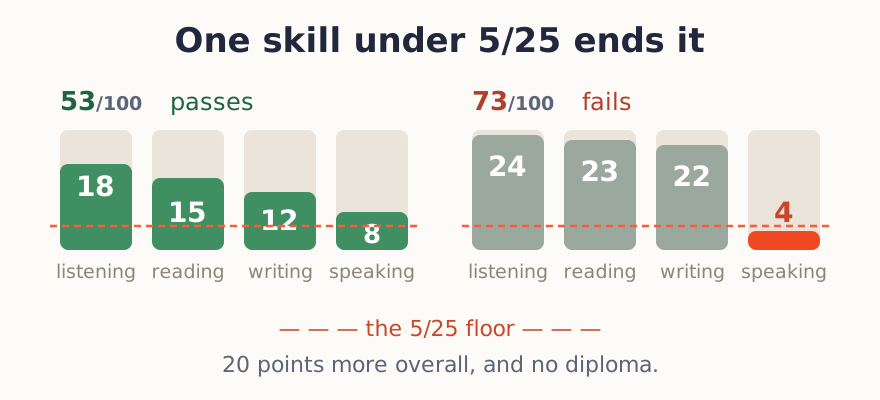
If one section is below 5/25, you fail even with a total above 50.
DELF vs TCF/TEF in one line: DELF gives a level diploma with no expiry; TCF/TEF give score attestations usually valid for 2 years. For immigration, TCF/TEF are accepted; for academic settings, requirements vary by institution.
What Your Scores Mean for Your Next Step
Now that each format is decoded, you can interpret your profile more intelligently. The value of your report is not just the final number, but the pattern across skills.
1) Score Patterns You Should Notice First
2) Compare Scores With Your Real Target
Before making any decision, compare your profile to the exact benchmark relevant to your application.
3) Identify the Skill That Needs Fast Improvement
Once targets are clear, isolate the lowest-return skill first and assign the next study cycle around it.
If listening is lowest: Increase volume of audio input and train with accent/speed variation.
If reading is lowest: Improve scan speed and vocabulary precision in practical texts.
If writing is lowest: Build correction loops around grammar and task completion.
If speaking is lowest: Increase live output frequency with timed response drills.
What to Do After Getting Results
At this point, interpretation should lead directly to action. The three scenarios below help you move quickly without overthinking.
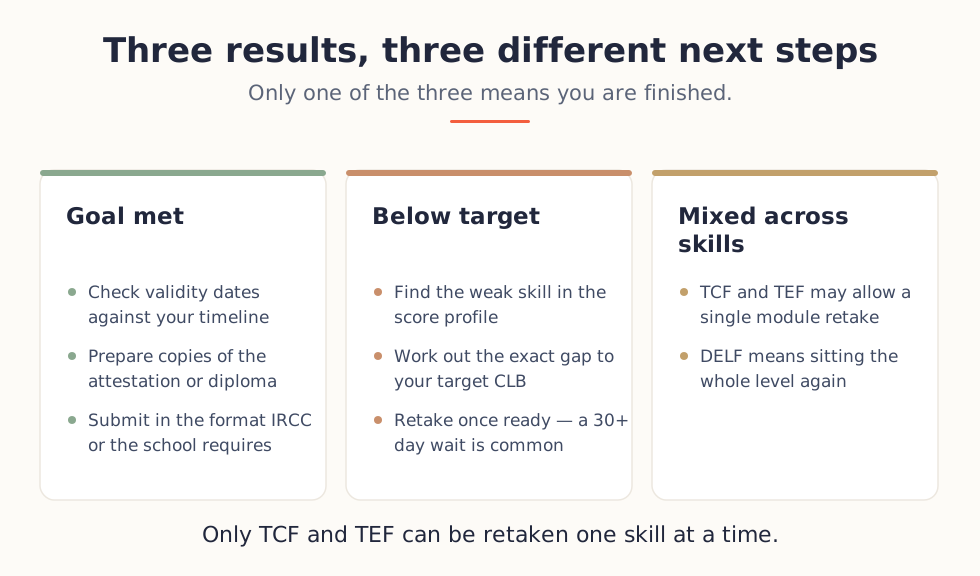
If Your Scores Already Meet the Goal
- Verify validity dates against your submission timeline
- Prepare copies of your attestation or diploma
- Submit to IRCC or institution with the correct format
- Keep improving even after submission
If Your Scores Are Below Target
- Identify weak skills from the score profile
- Calculate exact gap to target CLB/CEFR
- Build targeted plan for weak modules
- Schedule retake once readiness is stable (30+ day wait is common)
If Your Scores Are Mixed Across Skills
Sometimes one or two skills hit the target while others miss it. In this case, your test strategy matters as much as your study strategy.
- TCF/TEF: You may retake individual modules where available.
- DELF: You retake the full exam at that level.
Common Questions About Score Reports
To make this guide practical, here are the most frequent score-report questions candidates ask after receiving results.
Q1) How long does it usually take to receive results?
Q2) What if I lost my score report?
Q3) Can I combine scores from different tests?
Q4) What if my scores expire before processing finishes?
Q5) Are TCF and TEF scores valued differently?
Score Report Checklist
Before submission, run this quick quality check so avoidable issues do not delay your file.
- Verify your name spelling
- Confirm each skill is matched to the right score
- Check validity period
- Convert to CLB correctly (if immigration)
- Prepare certified copies if requested
- Store originals safely
Real DELF and TCF Canada tasks, scored like the exam
Months of preparation come down to a few hours in one room. Practise on DELF and TCF Canada A1-C2 tasks until nothing on the paper can surprise you.
- 990+ practice tasksWriting, speaking, reading and listening, all in DELF and TCF Canada format.
- Topics refreshed each quarter130 expert-curated writing topics, aligned with current exam trends.
- Examiner-standard markingScored against the official grid, with your level estimated.
- Detailed feedback on every errorWhy it costs you points, plus a model rewrite to learn from.
Free to start. Cancel anytime.
Or see how SavoirX prepares you for DELF and TCF Canada