
"How long will it take me to reach B2?" is one of the most common questions French learners ask. The honest answer: it depends on where you're starting and how you study.
Short answer: from B1, expect 150-250 hours, roughly 4-8 months at 10-15 hours of study per week. From A2, 350-450 hours. From A1, 500-650 hours. From no French at all, 600-800 hours and around two years. The table below breaks each one down.
This guide provides realistic timelines based on your current level, study intensity, and learning context.
How long it actually takes
General estimates to reach DELF B2:
Based on 10-15 hours of study per week
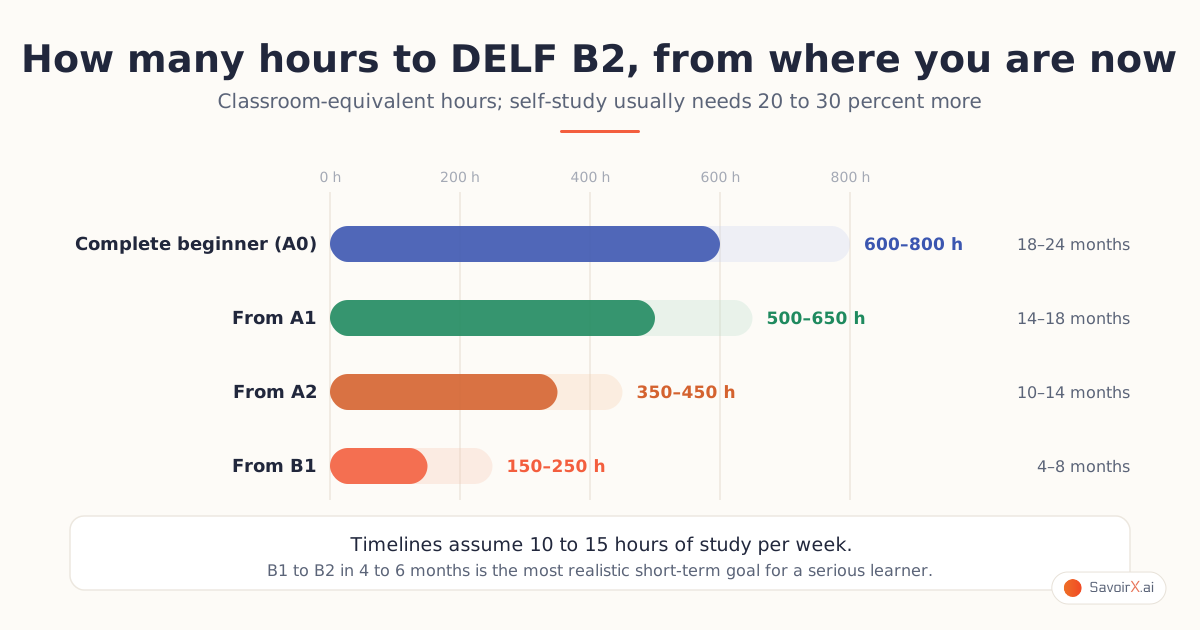
These are averages. Your actual timeline depends on many factors we'll explore below.
Understanding the CEFR Hour Guidelines
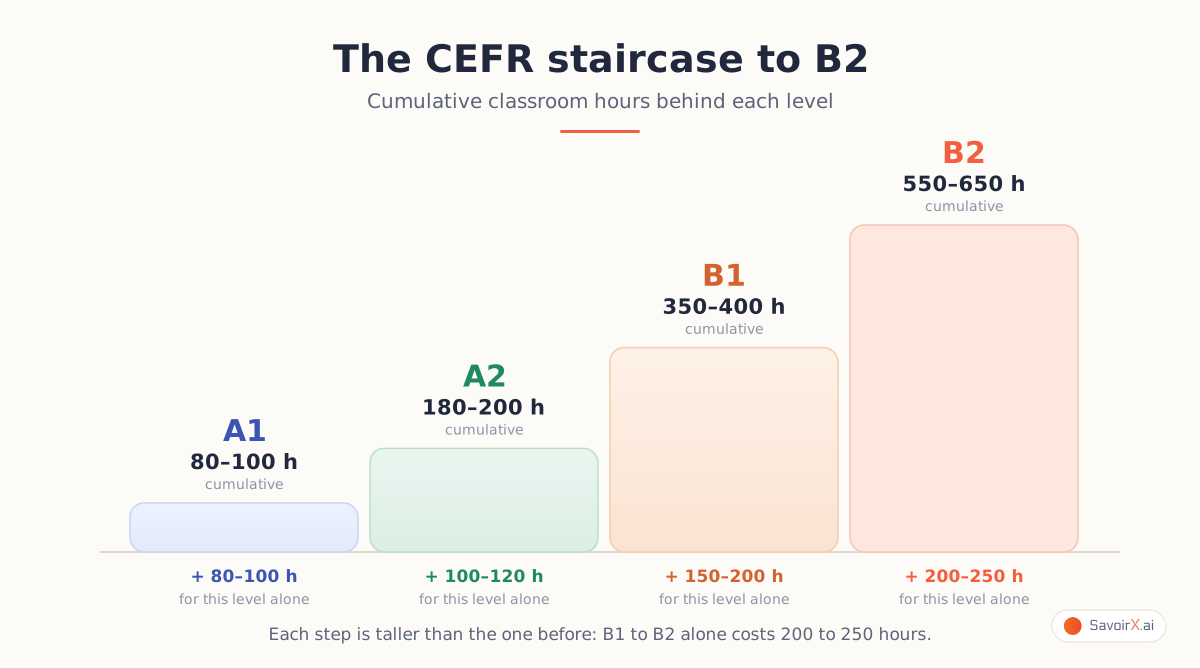
The Common European Framework of Reference (CEFR) provides general estimates for reaching each level:
Important: These are classroom hours with a teacher. Self-study typically requires 20-30% more time. Immersion environments can reduce time significantly.
Read across those two columns and one thing stands out: each level costs more than the one before it. The staircase below shows the same numbers as height.
Realistic Timelines by Starting Level
Where you are starting from matters more than how hard you work, because the distance to B2 is not the same from every starting point. These are the ranges to plan against.
From Complete Beginner (A0) to B2
Total time: 600-800 hours over 18-24 months
Breakdown:
- A0 to A1: 3-4 months (100 hours)
- A1 to A2: 3-4 months (120 hours)
- A2 to B1: 4-6 months (200 hours)
- B1 to B2: 4-8 months (200-250 hours)
Reality check: This is a significant commitment. Most people underestimate how much consistent effort is required.
From A1 to B2
Total time: 500-650 hours over 14-18 months
At A1, you have basic foundations:
- You know present tense and basic past
- You have ~500-1000 words vocabulary
- You can handle very simple conversations
What you need to build:
- Complex tenses (subjunctive, conditional, plus-que-parfait)
- 3000-4000 additional vocabulary words
- Abstract discussion skills
- Formal writing ability
From A2 to B2
Total time: 350-450 hours over 10-14 months
At A2, you can handle everyday situations:
- You use past tenses correctly
- You have ~1500-2000 words
- You can write simple texts
The A2-to-B2 jump is challenging because B2 requires:
- Nuanced argumentation
- Understanding implicit meaning
- Expressing complex opinions
- Formal register mastery
Many learners plateau at B1 and struggle to reach B2.
From B1 to B2
Total time: 150-250 hours over 4-8 months
At B1, you're independent:
- You handle most travel situations
- You express opinions on familiar topics
- You write connected texts
The B1-B2 gap is about depth, not breadth:
- From "I can express an opinion" to "I can argue convincingly"
- From "I understand main points" to "I understand nuance and implication"
- From "I make myself understood" to "I communicate with precision"
Good news: B1 to B2 is achievable in 4-6 months with focused, intensive study. This is the most realistic short-term goal for serious learners.
What changes the timeline
Two learners putting in the same hours can finish months apart, and the reasons divide cleanly into what accelerates progress, what stalls it, and the particular stall that catches almost everyone somewhere in the middle of B1.
Factors That Speed Up Progress
Two learners putting in identical hours can finish months apart. Five things account for most of that gap, and only some of them are under your control.
1. Immersion Environment
Living in a French-speaking country can cut your timeline by 30-50%.
Why it helps:
- Constant input (signs, conversations, media)
- Daily practice opportunities
- Motivation from real-world needs
- Cultural context understanding
Even without moving:
- Change your phone/computer to French
- Watch French media daily
- Find conversation partners online
- Surround yourself with French at home
2. Previous Language Experience
If you speak another Romance language (Spanish, Italian, Portuguese), expect faster progress:
- Similar grammar structures
- Shared vocabulary (cognates)
- Familiar learning patterns
Estimated advantage: 20-30% faster progress
3. Study Intensity and Consistency
| Study Pattern | Effectiveness | Notes |
|---|---|---|
| 30 min/day, every day | High | Best for retention |
| 2 hours, 3x/week | Medium | Good if consistent |
| 5 hours on weekends only | Lower | Too much gap between sessions |
| Intensive bootcamp | High short-term | Risk of burnout |
The key is consistency. Daily 30-minute sessions beat weekly 3-hour sessions.
4. Quality of Study Methods
Not all study hours are equal:
5. Focused Exam Preparation
Once you're near B2, dedicated DELF prep accelerates readiness:
- Learn the exam format
- Practice with past papers
- Get feedback on writing/speaking
- Target weak skills specifically
Recommended: 4-8 weeks of focused DELF B2 prep before your exam date.
Factors That Slow Progress
The things that stall progress are rarely dramatic. They are ordinary habits that feel like studying while producing very little.
1. Inconsistent Study
The biggest progress killer. Gaps longer than 2-3 days cause forgetting, requiring review time.
2. Passive Learning Only
Watching French TV without active engagement feels productive but builds passive skills only. You need active production (speaking, writing) to reach B2.
3. Avoiding Weak Areas
Many learners focus on strengths (often reading) and avoid weaknesses (often speaking). B2 requires competence in all four skills.
4. Perfectionism
Waiting until you're "ready" to speak or write delays the practice you need. Mistakes are essential for learning.
5. Wrong Level Materials
Studying content too easy (no challenge) or too hard (frustration) slows progress. Stay in the "slightly uncomfortable" zone.
Each of these five adds weeks to a timeline without adding skill. If your progress has stalled and you cannot say which of the five is responsible, that is usually a sign it is more than one of them.
The Plateau Problem
Many learners get stuck at B1 and struggle to reach B2. This is called the "intermediate plateau."
Why it happens:
- B1 is functional - you can communicate, so urgency decreases
- B2 requires qualitative improvement, not just more vocabulary
- Abstract skills (argumentation, nuance) are harder to develop
- Errors become fossilized if not corrected
How to break through:
- Get feedback on writing and speaking from qualified sources
- Study formal French - B2 requires register awareness
- Read opinion content - editorials, essays, debates
- Practice argumentation - not just expressing opinions, but defending them
- Focus on connectors - these transform B1 writing into B2
How to plan your study
Pick the plan that matches the hours you can genuinely protect each week, not the one that reaches the exam soonest. A plan you abandon in week five costs more time than a slower plan you finish.
Intensive Plan: B1 to B2 in 4 Months
For: Full-time students or those with significant free time
Hours: 20-25 hours/week
| Week | Focus | Activities |
|---|---|---|
| 1-4 | Grammar gaps | Subjunctive, conditional, complex tenses |
| 5-8 | Vocabulary expansion | Topic-based vocabulary, formal expressions |
| 9-12 | Skills practice | Writing essays, speaking practice, listening |
| 13-16 | Exam prep | Past papers, timed practice, feedback |
Moderate Plan: B1 to B2 in 6 Months
For: Working professionals
Hours: 10-12 hours/week
| Month | Focus |
|---|---|
| 1 | Assess gaps, build study routine |
| 2 | Grammar: subjunctive and conditional |
| 3 | Vocabulary: formal register, connectors |
| 4 | Writing: essay structure, letter formats |
| 5 | Speaking: argumentation, pronunciation |
| 6 | Full exam preparation |
Relaxed Plan: A2 to B2 in 12 Months
For: Casual learners with long-term goals
Hours: 5-7 hours/week
| Quarter | Focus |
|---|---|
| Q1 | Solidify A2, begin B1 grammar |
| Q2 | B1 completion, vocabulary building |
| Q3 | Begin B2 content, writing practice |
| Q4 | B2 completion, exam preparation |
How to Know If You're Ready for DELF B2
Before registering, honestly assess:
Listening
- Can you understand French news broadcasts?
- Can you follow movies without subtitles (mostly)?
- Can you understand different accents?
Reading
- Can you read newspaper articles without constant dictionary use?
- Can you understand opinion pieces and arguments?
- Can you identify the author's viewpoint?
Writing
- Can you write a 250+ word argumentative essay?
- Can you use formal register appropriately?
- Can you structure ideas logically with connectors?
Speaking
- Can you discuss abstract topics for 5+ minutes?
- Can you defend an opinion when challenged?
- Can you speak without long pauses to find words?
Readiness test: Try a full DELF B2 practice exam under real conditions. If you score 55-60+, you're likely ready. Below 50, give yourself more preparation time.
Your Personal Timeline
To estimate your timeline:
- Assess your current level honestly
- Calculate hours needed (use table at top)
- Determine your weekly availability
- Divide hours by weekly study time
- Add 20% buffer for life interruptions
Example:
- Current level: A2
- Hours needed: ~400
- Weekly availability: 10 hours
- Raw timeline: 40 weeks (10 months)
- With buffer: 12 months
Next Steps
- Take a placement test to know your true current level
- Set a realistic target date based on your timeline
- Create a study plan with weekly goals
- Register for DELF 3-4 months before your target date (creates accountability)
- Track your progress and adjust as needed
What B2 actually means
B2 gets described in ways that set candidates up to be disappointed by their own success, so it is worth being precise about what the level actually is.
What B2 Is
- Understanding complex texts on concrete and abstract topics
- Speaking fluently enough for regular interaction with natives
- Writing clear, detailed text on a wide range of subjects
- Explaining viewpoints with advantages and disadvantages
What B2 Is Not
- Native-like fluency (that's C2)
- Error-free French (errors are still common at B2)
- Understanding everything (specialized content may still be difficult)
- Speaking without accent (accent is separate from level)