
DELF A1 Complete Preparation Guide (2026)
DELF A1 is your first step into officially certified French. It proves you can handle basic interactions - introducing yourself, asking simple questions, and understanding everyday expressions.
This guide covers everything you need to prepare and pass.
What is DELF A1?
DELF A1 is the beginner level of the DELF certification system. It corresponds to the first level of the CEFR (Common European Framework of Reference).
What Can You Do at A1?
At A1 level, you can:
- Introduce yourself and others
- Ask and answer simple questions about personal details
- Interact in a basic way if the other person speaks slowly
- Write short, simple messages (postcards, forms)
What the exam involves
Now that you have a clear picture of what A1 represents, the next step is to understand exactly how the exam is organized so you can prepare with a clear method.
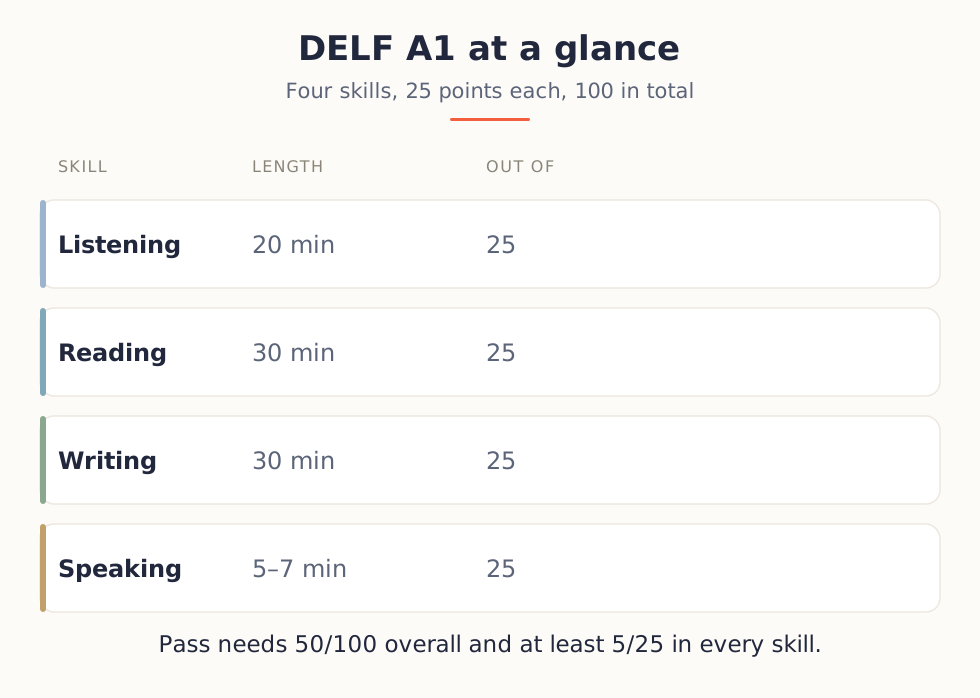
The exam tests four skills in this order:
1. Listening Comprehension (Comprehension de l'oral)
To start, listening checks whether you can catch key information quickly in realistic daily contexts.
- Short announcements (train stations, shops)
- Phone messages
- Simple conversations
- Instructions or directions
In other words, your objective is not to understand every single word, but to identify the practical details that drive the answer.
2. Reading Comprehension (Comprehension des ecrits)
After listening, the reading section measures how efficiently you can extract useful information from short, functional texts.
- Store signs and notices
- Simple emails or text messages
- Schedules and timetables
- Short advertisements
- Postcards or invitations
This section rewards clear scanning habits: find the right line quickly, then verify details like time, price, and conditions.
3. Writing Production (Production ecrite)
The third skill shifts from recognition to production, which means you now need to build short but accurate written output.
At A1 level, simple and correct is always stronger than long and risky, so clarity should stay your top priority.
Exercise 1: Form/Registration (10-15 minutes)
Fill out a registration form with personal information:
- Name, age, nationality
- Address, phone, email
- Hobbies, preferences
Exercise 2: Short message (15-20 minutes)
Write a simple text (postcard, email, note):
- Thank someone
- Invite someone
- Describe your day
- Ask for information
4. Speaking Production (Production orale)
Finally, the speaking section checks your ability to interact in real time using polite, basic, and understandable French.
The examiner mainly looks for functional communication, so steady delivery and relevant answers matter more than complex language.
- Guided interview (1 min): Answer questions about yourself
- Information exchange (2 min): Ask questions using prompt cards
- Role-play (2-3 min): Simple everyday scenario (buying something, asking directions)
Scoring and Passing
Once you understand the four tested skills, it becomes easier to see how your final result is calculated and what passing actually requires.
How Scoring Works
To Pass DELF A1
You need:
- 50/100 overall (50%)
- At least 5/25 in each skill
Important: Even if you score 95/100 overall, you'll fail if any single skill is below 5/25. Practice all four skills!
So your preparation strategy should stay balanced: secure your stronger skills, but never leave a weak section unattended.
What you need to know
Three bodies of material sit behind an A1 pass, and they are small enough to be listed in full: the topics the exam draws on, the grammar it expects, and the vocabulary you need to have ready.
Essential A1 Topics to Master
With the exam format and scoring in mind, you can now focus your revision on the core themes that appear most often at A1 level.
- Name, age, nationality
- Address, phone number, email
- Family members
- Job/studies
- Daily routines (wake up, eat, work, sleep)
- Days of the week, months
- Time expressions
- Basic activities
- Home and rooms
- City locations (bank, post office, supermarket)
- Countries and cities
- Prices and money
- Food and drinks
- Clothes and colors
- Basic transactions
- Physical descriptions
- Personality (simple adjectives)
- Likes and dislikes
Essential A1 Grammar
After topic coverage, grammar gives you the sentence patterns you need to answer clearly and avoid avoidable mistakes.
Verb Tenses
At A1, focus on these:
Present tense (le present):
- Regular -er verbs: je parle, tu parles, il parle...
- Key irregular verbs: être, avoir, aller, faire, venir
Near future (futur proche):
- Je vais manger (I'm going to eat)
Recent past (passe recent):
- Je viens de manger (I just ate)
These three patterns already cover a large part of beginner communication, so mastering them gives you a strong return in every section.
Key Structures
Numbers and Time
- Numbers 1-100 (and prices)
- Telling time: Il est trois heures et demie
- Days: lundi, mardi, mercredi...
- Months: janvier, fevrier, mars...
Because dates, prices, and schedules appear constantly in DELF A1, this mini-block should be revised frequently, not occasionally.
Essential A1 Vocabulary
Once grammar is stable, vocabulary helps you react faster in listening, reading, speaking, and writing tasks.
High-Frequency Words
Aim to know 500-800 words for A1. Priority categories:
This vocabulary base is enough to understand the most frequent A1 prompts and to produce short, reliable answers.
Useful Expressions
Treat these as reusable building blocks: the more automatic they become, the more confident and fluent your responses will feel.
How to prepare
To connect all of the points above in a practical way, follow this week-by-week roadmap and keep your workload consistent.
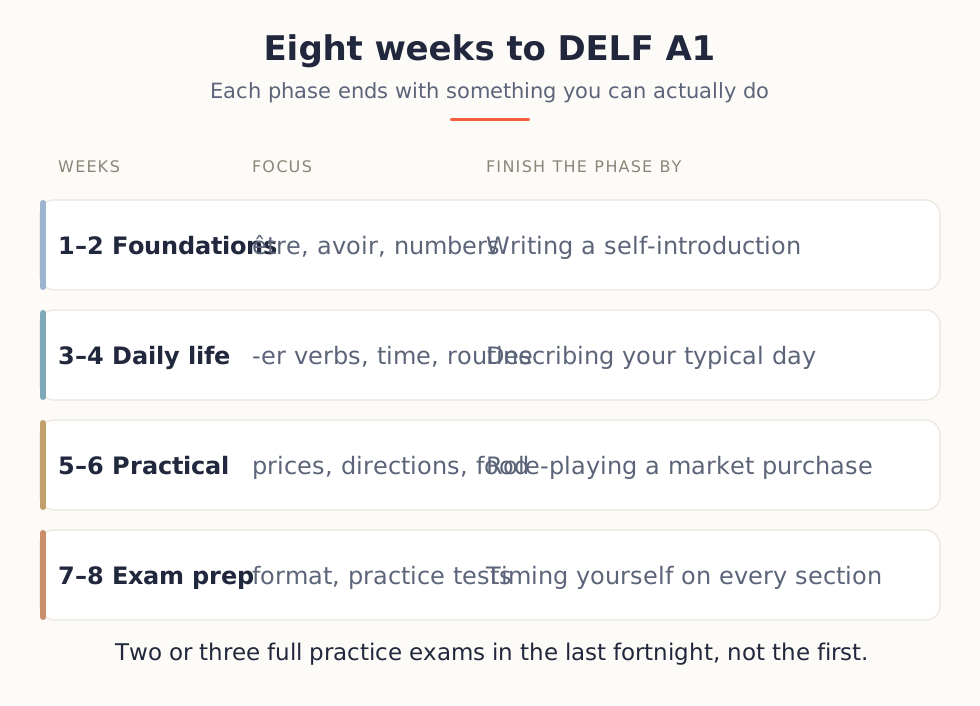
Week 1-2: Foundations
Focus: Basic verbs, greetings, personal information
- Learn être, avoir, aller, faire
- Practice introductions
- Study numbers 1-100
- Master basic questions (comment, ou, quand)
Practice: Write a self-introduction (30-50 words)
This opening phase is about accuracy and habit-building, so keep your sessions short, daily, and repetitive.
Week 3-4: Daily Life
Focus: Routines, time, activities
- Present tense of regular -er verbs
- Days, months, seasons
- Telling time
- Daily routine vocabulary
Practice: Describe your typical day
At this stage, your objective is to move from isolated words to short, connected routines you can say or write naturally.
Week 5-6: Practical Situations
Focus: Shopping, directions, services
- Prices and transactions
- Places in a city
- Asking for and giving directions
- Ordering food
Practice: Role-play buying items at a market
Here, practical communication becomes central, so simulate real situations as often as possible instead of only memorizing lists.
Week 7-8: Exam Preparation
Focus: Exam format, practice tests
- Complete 2-3 full practice exams
- Identify and fix weak areas
- Practice speaking tasks with timer
- Review common mistakes
Practice: Time yourself on all sections
In the final phase, the goal is stability under time pressure: same format, same timing, same correction routine.
Tips for Each Section
With your study plan in place, these section-by-section tips help you turn preparation into better test-day performance.
Listening Tips
- Read questions first - You have time before audio plays
- Listen for keywords - Match to what you hear
- Use context clues - Background sounds help identify settings
- Don't panic - Audio plays twice; use second time to confirm
- Write something - Partial answers are better than blank
Common listening topics:
- Opening hours
- Appointment times
- Phone numbers
- Simple directions
- Weather
When these themes repeat in practice, your response speed usually improves quickly.
Reading Tips
- Scan before reading deeply - Get the general idea
- Look for cognates - Many French-English similarities
- Watch for numbers - Dates, times, prices are common questions
- Read questions carefully - Sometimes answers are obvious
- Trust your instincts - At A1, texts are straightforward
Common reading formats:
- Menus and price lists
- Event posters
- Email invitations
- Train/bus schedules
- Simple advertisements
So while training, prioritize skimming structure first, then confirming key details.
Writing Tips
For the form exercise:
- Write clearly and legibly
- Use appropriate format (date format, phone format)
- Don't leave blanks
- Double-check spelling of common words
For the message exercise:
- Address the task directly
- Keep sentences simple
- Use connectors: et, mais, parce que
- Check verb agreements
- 40-50 words is enough - don't over-write
Sample A1 writing task:
You just moved to a new city. Write an email to your French friend to tell them about your new home.
Sample response:
Salut Marie!
Je suis dans ma nouvelle maison! C'est petit mais très joli. Il y a deux chambres et un jardin. J'habite près du centre-ville. C'est super!
Tu veux venir ce weekend?
Bisous, Pierre
Notice how the message stays short, direct, and complete, which is exactly what A1 examiners expect.
Speaking Tips
- Stay calm - The examiner is friendly and patient
- Speak simply - Short, correct sentences are better than complex, wrong ones
- Don't freeze - If you don't understand, ask: Pouvez-vous répéter ?
- Use filler phrases - Alors..., Eh bien..., Voyons... give you thinking time
- Be polite - Bonjour, merci, au revoir matter
Part 2 (Asking questions) - Strategy:
You get cards with images or words. Form questions:
This is why practicing question patterns in advance can significantly reduce hesitation during the oral test.
Common Mistakes to Avoid
At this point, it is useful to review recurring error patterns so you can avoid losing easy points in each skill.
Grammar Mistakes
Vocabulary Mistakes
Speaking Mistakes
- Speaking too fast (slow down!)
- Not using vous in formal situations
- Forgetting to greet the examiner
- One-word answers instead of sentences
Avoiding these small traps often leads to a noticeably cleaner speaking score, even without advanced vocabulary.
Practice Resources
After identifying mistakes, the next step is to build a consistent routine using reliable resources and simple daily tasks.
Free Resources
- TV5Monde A1 exercises: Grammar and vocabulary
- RFI Savoirs: Easy French listening
- France Éducation international: Official sample exams
- YouTube: Many free DELF A1 preparation videos
Practice Activities
- Label your home - Sticky notes with French words
- Change phone language - Immerse yourself
- Daily journal - Write 3 sentences about your day
- Listen to podcasts - Slow French content for beginners
- Talk to yourself - Describe what you're doing
The key is consistency: small daily repetition is more effective than occasional long sessions.
Sample Practice Test
To make your revision more concrete, here are short sample items that mirror the type of information A1 tasks usually test.
Try these sample questions:
Listening (Sample)
Audio transcript: "Bonjour, c'est le cabinet du docteur Martin. Votre rendez-vous est confirmé pour mardi 15 mars a 10 heures. Merci d'apporter votre carte d'identité."
Questions:
- What type of appointment is this? (Doctor)
- What day is the appointment? (Tuesday, March 15)
- What should the person bring? (ID card)
Reading (Sample)
Text: "BOULANGERIE DUVAL - Ouverte du lundi au samedi, de 7h a 19h. Fermée le dimanche. Pain frais tous les jours!"
Questions:
- What type of shop is this? (Bakery)
- Is it open on Sunday? (No)
- What time does it close? (7 PM)
Use these examples as templates: change topic, keep structure, and train your reflexes for exam-like questions.
What to do on exam day
As exam day approaches, keep your checklist simple and practical so you can focus your energy on performance.
- Bring valid ID (passport or national ID)
- Arrive 15 minutes early
- Bring pens (blue or black ink)
- No phones or electronic devices
- Stay calm and do your best
You've got this! DELF A1 is achievable with consistent practice. Focus on the basics, practice regularly, and trust your preparation.
After DELF A1
Once A1 is done, the best momentum strategy is to continue immediately with your next realistic target.
Once you pass A1, consider:
- DELF A2 - The next step (routine tasks, simple conversations)
- Continue studying - Build toward B1/B2
- Practice speaking - Find conversation partners
Ready to practice? Start with SavoirX to build your French skills with instant AI feedback.
Related Articles
To continue progressively after this guide, use the resources below in sequence based on your next target level.