
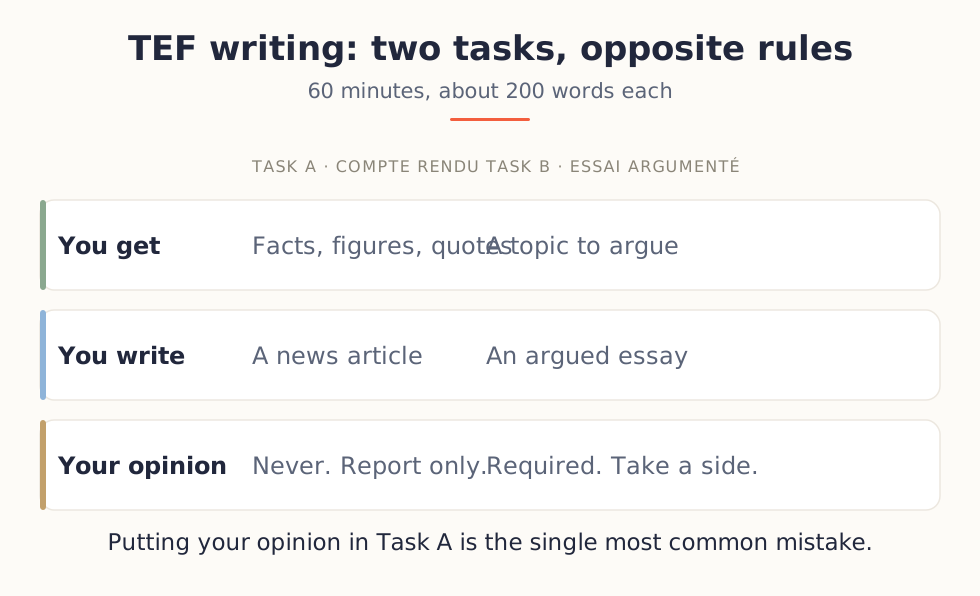
The writing section of TEF Canada (Expression écrite) consists of two tasks completed in 60 minutes. Unlike TCF's three shorter tasks, TEF requires two longer pieces of writing, each around 200 words. This guide covers both tasks with strategies, structures, and examples to help you achieve CLB 7 or higher.
How the writing section works
Before going into methods and model responses, this overview gives you the practical exam frame you need for planning and pacing.
CLB Score Conversion (Writing):
Task A: News Article (Compte rendu)
The first task asks you to write a news article based on information provided. You'll receive facts, data, or a scenario and must present them as a journalist would.
What You're Given
The prompt typically includes:
- A situation or event (e.g., a new policy, an incident, a community initiative)
- Key facts, statistics, or quotes
- Instructions on what to include
What Examiners Expect
Your article should:
- Present information objectively (no personal opinion)
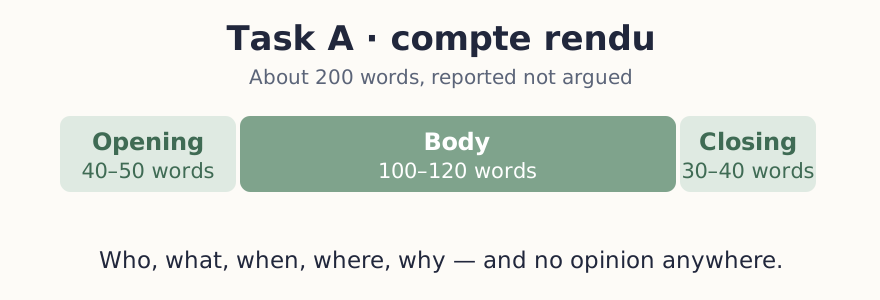
- Follow journalistic structure (who, what, when, where, why)
- Use appropriate formal register
- Be clear and well-organized
- Demonstrate varied vocabulary and correct grammar
Recommended Structure
Headline (optional but impressive) A concise, informative title
Opening paragraph (40-50 words) The lead paragraph answers the essential questions: What happened? Who is involved? When and where?
Body paragraphs (100-120 words) Develop the story with details, context, and quotes if provided. Organize logically, from most to least important information.
Closing (30-40 words) Conclude with implications, next steps, or broader context.
Example Task A
Prompt: Based on the following information, write a news article. Minimum 80 words, 25 minutes.
- The city of Lyon is implementing a new bike-sharing program
- 500 electric bikes will be available starting March 1, 2026
- Stations will be placed near metro stops and universities
- Cost: €1 for 30 minutes, free for annual subscribers
- Goal: reduce car traffic by 15% in the city center
- Quote from Mayor: "This is a step toward a greener Lyon"
Sample Response:
Sample Response · Task A
Lyon lance un nouveau programme de vélos électriques en libre-service
La ville de Lyon annonce le déploiement d'un nouveau programme de vélos électriques en libre-service, prévu pour le 1er mars 2026. Cette initiative vise à réduire la circulation automobile de 15 % dans le centre-ville.
Le programme mettra à disposition 500 vélos électriques répartis dans des stations situées à proximité des arrêts de métro et des campus universitaires. Les usagers pourront emprunter un vélo pour 1 € les 30 minutes, tandis que les abonnés annuels bénéficieront de la gratuité du service.
« C'est un pas vers un Lyon plus vert », a déclaré le maire lors de la présentation du projet. La municipalité espère que ce nouveau mode de transport incitera les habitants à délaisser leur voiture pour les trajets courts.
Les détails concernant l'inscription au programme seront communiqués dans les semaines à venir sur le site officiel de la ville.
- Answers who, what, when, where, why
- Uses formal journalistic language
- Includes the provided quote appropriately
- Has clear structure and logical flow
- 151 words: well over the 80-word minimum. You can score with far less, so do not spend Section B's time here
A second Task A, worked
La bibliothèque Jean-Moulin ferme pour dix-huit mois de travaux
La bibliothèque Jean-Moulin, à Nantes, fermera ses portes le 6 avril pour une rénovation complète. Les travaux, estimés à 4,2 millions d'euros, doivent s'achever en septembre 2027.
Pendant cette période, les 40 000 ouvrages seront transférés dans un local provisoire, rue Duguay-Trouin, qui restera accessible aux abonnés aux horaires habituels.
« Nous voulions un lieu ouvert le soir », a expliqué la directrice de l'établissement, qui présente le chantier comme une adaptation aux nouveaux usages plutôt qu'une simple remise à neuf.
Why it scores · 90 words. Every figure from the prompt is used once, the quote is placed rather than padded, and the last sentence does the work most candidates skip: saying what the fact means. No invented detail.
Task B: Argumentative Essay (Essai argumenté)
The second task asks you to express and defend a viewpoint on a given topic. This tests your ability to structure an argument, use persuasive language, and demonstrate command of formal French. Unlike Task A, you are now expected to take a clear stance and sustain it.
What You're Given
A topic or question, often relating to:
- Social issues (technology, environment, education)
- Lifestyle choices (remote work, travel, consumption)
- Abstract debates (tradition vs. modernity, individual vs. collective)
What Examiners Expect
Your essay should:
- Present a clear thesis
- Develop arguments with examples
- Use logical connectors
- Show formal register
- Have a coherent structure
Recommended Structure
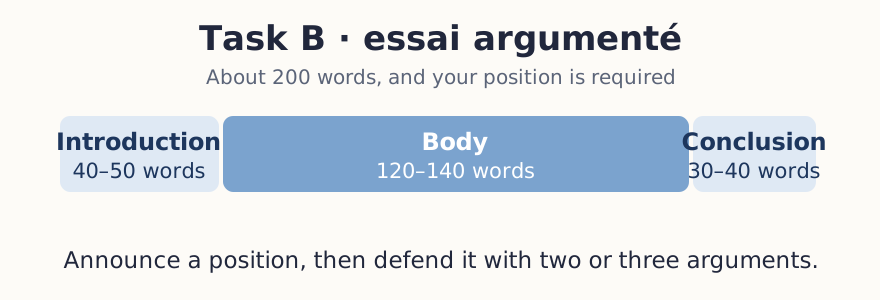
Introduction (40-50 words)
- Hook or context
- State the topic
- Announce your position
Body paragraphs (120-140 words)
- 2-3 arguments supporting your position
- Each argument with explanation or example
- Connected with appropriate transitions
Conclusion (30-40 words)
- Summarize main points
- Reinforce thesis
- Optional: broaden perspective
Essential Connectors for B2+
To achieve CLB 7 or higher, use varied connectors:
Example Task B
Prompt: Pensez-vous que le télétravail devrait devenir la norme pour les emplois de bureau ? Exprimez et défendez votre point de vue. Minimum 200 mots, 35 minutes.
(Do you think remote work should become the norm for office jobs? Express and defend your viewpoint.)
Sample Response:
Sample Response · Task B
Le télétravail s'est généralisé depuis quelques années, et nombreux sont ceux qui souhaitent qu'il devienne permanent. Je pense que cette pratique devrait effectivement devenir la norme pour les emplois de bureau, bien qu'une certaine flexibilité reste nécessaire.
Tout d'abord, le travail à distance offre un meilleur équilibre entre vie professionnelle et vie personnelle. Les employés économisent du temps de transport, ce qui leur permet de consacrer davantage de moments à leur famille ou à leurs loisirs. Par ailleurs, de nombreuses études démontrent que la productivité augmente lorsque les travailleurs peuvent organiser leur journée selon leurs préférences.
En outre, le télétravail présente des avantages environnementaux non négligeables. La réduction des déplacements quotidiens diminue les émissions de CO2 et contribue à la lutte contre le changement climatique.
Cependant, il convient de préserver des moments de présence au bureau pour favoriser la cohésion d'équipe et la créativité collective. Un modèle hybride semble donc idéal.
En conclusion, le télétravail devrait devenir la norme, avec une flexibilité permettant des rencontres ponctuelles en présentiel. Les entreprises et les employés y trouveraient tous des bénéfices.
Encore faut-il que les entreprises revoient leur façon d'évaluer le travail : tant que la présence au bureau tiendra lieu de preuve d'implication, le télétravail restera un arrangement toléré plutôt qu'une norme assumée.
- Clear position stated in introduction
- Two main arguments with development
- Uses varied connectors (tout d'abord, par ailleurs, en outre, cependant, en conclusion)
- Acknowledges counterpoint (nuanced argument)
- Strong conclusion that reinforces thesis
- 211 words: over the 200-word minimum, which is where Section B is scored
A second Task B, worked
La gratuité des transports en commun revient régulièrement dans le débat public, et plusieurs villes l'ont déjà adoptée. Je considère qu'elle est souhaitable, mais qu'elle ne suffit pas à elle seule.
D'abord, la mesure a un effet social immédiat. Pour un ménage modeste, l'abonnement représente une dépense contrainte, et la supprimer revient à redonner du pouvoir d'achat sans démarche administrative. À Dunkerque, la fréquentation a augmenté de plus de moitié après le passage à la gratuité, ce qui montre que le prix décourageait bien une partie des usagers.
Ensuite, on ne peut pas ignorer la question du financement. Les recettes des billets ne couvrent qu'une part du coût réel du réseau, mais cette part doit être compensée, faute de quoi c'est la qualité du service qui se dégrade. Or un bus gratuit mais bondé et irrégulier ne convaincra personne d'abandonner sa voiture.
On objectera que la gratuité profite aussi à ceux qui n'en ont pas besoin. C'est exact, mais un tarif social suppose un contrôle des revenus, donc des dossiers, des guichets et des non-recours : le coût administratif finit par annuler l'économie réalisée.
C'est pourquoi la gratuité me paraît défendable à une condition : qu'elle s'accompagne d'un investissement dans la fréquence et l'entretien du réseau. Sans cela, on aura simplement rendu gratuit un service que plus personne ne veut utiliser.
Why it scores · 221 words. It takes a position in the first sentence and qualifies it, then gives one concrete case (Dunkerque) rather than a general claim. The third paragraph concedes the strongest counter-argument instead of ignoring it, which is what separates a B2 answer from a C1 one at TEF.
How it is scored
TEF evaluators assess your writing on:
Each criterion affects your score. A grammatically perfect text that doesn't answer the question won't score well, and vice versa.
How to prepare
With 60 minutes for two tasks, manage your time carefully:
Pro tip: Start with whichever task you find easier to build confidence. Some prefer Task A because it's more structured; others prefer Task B because they can express their ideas freely.
Building Your Vocabulary
For CLB 7+, demonstrate range beyond basic vocabulary:
For News Articles (Task A)
For Argumentative Essays (Task B)
Practice Approach
The two tasks reward different preparation, so practising them as one thing wastes half the effort.
For Task A
- Read French news articles daily (Le Monde, Radio-Canada)
- Practice summarizing articles in your own words
- Learn journalistic vocabulary and phrasing
- Time yourself writing practice articles
For Task B
- Practice forming opinions on current topics
- Write argumentative paragraphs with connectors
- Get feedback on structure and logic
- Build a repertoire of examples you can adapt
Common Mistakes to Avoid
The errors that cost most are specific to each task, and they are close to opposites: Task A penalises the personal opinion that Task B is built on.
In Task A (News Article)
- Including personal opinion - News articles are objective. Avoid "je pense que" or value judgments.
- Missing key information - If the prompt gives you facts, use them. Leaving out provided information loses points.
- Wrong register - News articles use formal, neutral language. Avoid colloquialisms.
- Poor structure - Don't bury the main news. Lead with the most important information.
In Task B (Argumentative Essay)
- No clear thesis - Your position must be evident from the introduction.
- Undeveloped arguments - Don't just list points. Explain why each argument supports your position.
- No connectors - Essays without transitions feel choppy. Use connectors between and within paragraphs.
- Informal language - Even when expressing opinions, maintain formal register.
- Off-topic tangents - Stay focused on the question asked.
Final Tips
Test-Day Checklist
- Read the prompt twiceMake sure you understand what's being asked before writing.
- Plan before writingEven 2-3 minutes of planning produces better-organized texts.
- Count your wordsStaying close to the target word count shows you can express ideas concisely.
- Save time for reviewQuick proofreading catches obvious errors in spelling and agreement.
- Write legibly (if paper-based) — Examiners can't give points for what they can't read.
Real TEF Canada tasks, scored like the exam
Months of preparation come down to a few hours in one room. Practise on TEF Canada B1-C1 tasks until nothing on the paper can surprise you.
- 140+ writing tasksBuilt by our content team to the official TEF Canada format and marking criteria.
- Full writing mock exams10 complete papers, timed to the real exam.
- Examiner-standard markingScored against the official grid, with your level estimated.
- Detailed feedback on every errorWhy it costs you points, plus a model rewrite to learn from.
Free to start. Cancel anytime.
Or see how SavoirX prepares you for TEF Canada