
TCF Canada Writing Task 2: Templates and Phrases for 120-150 Words
At a glance
- Task type: Informal letter or email to a friend
- Word count: 120-150 words
- Register: Familier or courant, with tu / toi throughout
- Where marks are lost: Inconsistent register and wrong tenses
Introduction: Is TCF Task 2 the "Easy Win" Task?
The TCF Canada Writing Section (Expression Écrite) requires candidates to write a letter or email to a friend or acquaintance, usually to express thanks, apologies, invitations, or suggestions. The word count requirement is 80 to 120 words.
Why is this often considered the "Easy Win" task?
- Simple Format: Compared to the argumentative essay in Task 3, Task 2 only requires a non-formal (*familier*) or semi-formal (*courant*) tone.
- Relatable Topics: Subjects are typically real-life situations like parties, travel, complaints about a service, or invitations.
However, many candidates still lose marks on this task, mainly due to inaccurate register (*registre*) and tenses.
Therefore, to help candidates avoid these common pitfalls, this guide provides a complete Task 2 strategy.
This guide will provide a universal structural template for Task 2 and focus on explaining how to use high-scoring phrases to convey emotions and offer suggestions.
TCF Task 2: Typical Prompt Example
Before diving into the structure, let's examine a typical Task 2 prompt to understand the requirements.
Votre ami(e) Paul/Paula a récemment déménagé dans une nouvelle ville et vous invite à passer le week-end chez lui/elle pour visiter. Vous ne pouvez pas venir à la date proposée, mais vous souhaitez le/la remercier chaleureusement et proposer une alternative pour vous retrouver prochainement. Vous lui écrivez un courriel de 120 à 150 mots.
(Your friend Paul/Paula has recently moved to a new city and invited you to spend the weekend with him/her for a visit. You cannot make it on the proposed date, but you want to thank him/her warmly and suggest an alternative plan to meet soon. Write an email of approximately 80 words.)
3 Key Pillars for a High Task 2 Score: Register, Structure, and Tenses
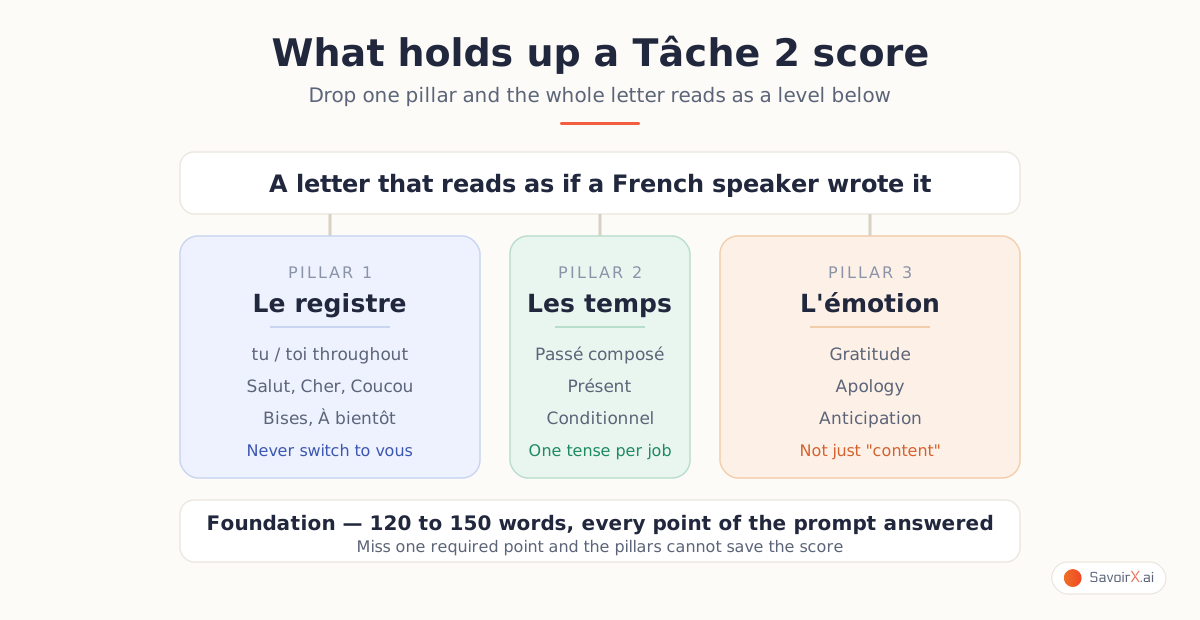
To successfully address the prompt above, candidates must master these three core elements.
Task 2 aims to test your daily communication skills. To achieve a high score, you must meet these three criteria:
- Consistent Register (*Le Registre*): You must use informal or semi-formal greetings (e.g., Salut, Cher/Chère) and friendly sign-offs (e.g., Bisous, À bientôt). Contractions and the familiar pronoun (tu/toi) are expected.
- Golden Tenses: Use Passé Composé for past events, and Présent or Conditionnel Présent for questions or suggestions.
- Emotional Expression: You must use rich adjectives and verbs to express your feelings (joy, apology, anticipation, etc.).
4 Steps: Quick Strategy for TCF Task 2 Writing
Now that we understand the high-score requirements, let's learn how to efficiently complete a Task 2 email within the tight time limit.
To complete all requirements within 120-150 words, you need a quick planning phase before you start writing.
1. Define Role and Task (Qui, Quoi, Pourquoi)
- Role: Who am I? Who am I writing to? (A friend, so definitively use tu.)
- Purpose: What are the main objectives of the letter? (E.g., for this prompt: "Thank," "Apologize/Explain," and "Suggest an alternative.")
- Word Limit: Keep the 120-150 words in mind. Do not write too long, or you may run out of time for Task 3.
2. Outline the Structure (Quatre parties)
- Quickly jot down the four essential parts of the letter to ensure completeness:
- Opening: Greeting + Small talk (1-2 sentences)
- Main Subject: Thank for invitation + Apology/Explanation (2-3 sentences)
- Development: Propose a new plan/date + Ask for feedback (2-3 sentences)
- Closing: Express anticipation + Friendly sign-off (2 sentences)
3. Select High-Scoring Phrases (Les Mots Clés)
- Pre-select 2-3 high-scoring expressions based on your main purpose, and ensure you use them:
- Thanking: Je te suis extrêmement reconnaissant(e) (I am extremely grateful to you)
- Apologizing: Je te prie de bien vouloir m'excuser (Please forgive me)
- Proposing: Qu'en penses-tu si l'on se voyait...? (What do you think if we meet...?)
4. Quick Self-Check (Vérification Rapide)
- After writing, quickly check two key points:
- Register: Did I use tu and a friendly sign-off throughout?
- Task Fulfillment: Did I include all three core tasks required by the prompt (thanking, apologizing, proposing alternative)?
These steps ensure that you avoid structural errors, laying the foundation for incorporating advanced phrases.
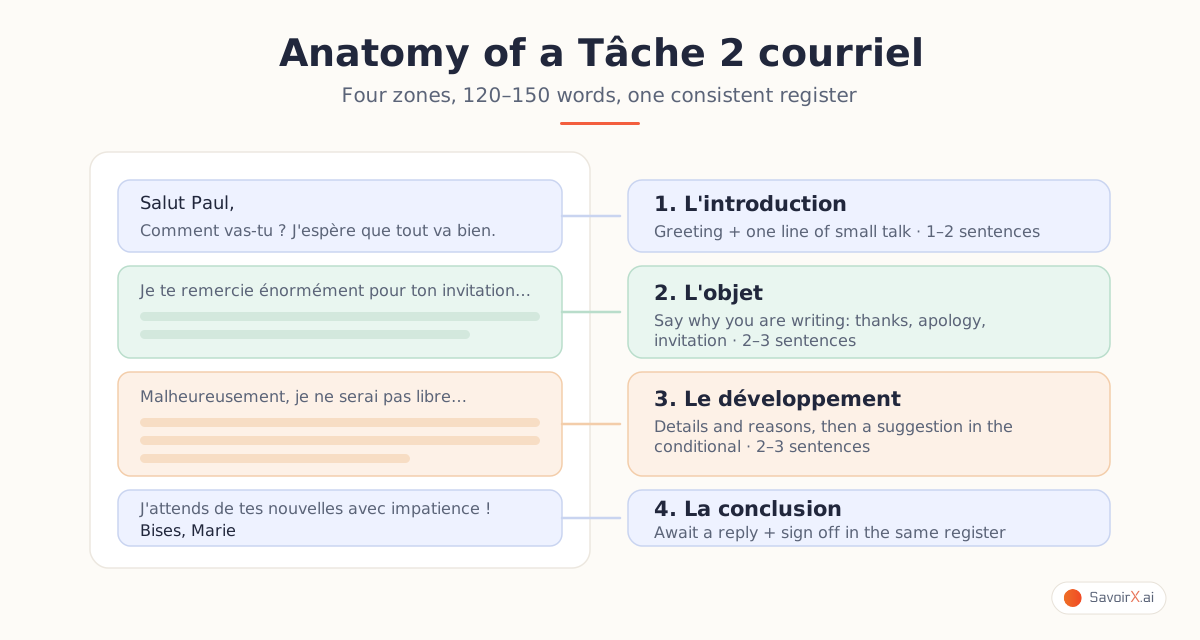
5. TCF Task 2: Universal Writing Template (Content Expansion)
Regardless of whether the theme is an invitation, a thank you, or an apology, your email/letter should follow these four essential parts. Below is a detailed look at how to use high-scoring language in each section.
1. Greeting and Opening (L'introduction)
- 【Salutation】 Always use a friendly salutation, for example:
- Salut (Nom de l'ami),
- Cher/Chère (Nom de l'ami),
- Coucou (Nom de l'ami), (More colloquial, very intimate)
- 【Small Talk】 Use natural greetings, mentioning the last contact:
- Comment vas-tu ? J’espère que tout va bien de ton côté. (How are you? I hope everything is well on your end.)
- Ça fait longtemps qu'on ne s'est pas parlé ! J'espère que tu as passé de bonnes vacances. (It's been a long time since we last spoke! I hope you had a good holiday.)
- Je t'écris suite à notre conversation de la semaine dernière. (I am writing to you following our conversation last week.)
2. Main Subject (L'objet)
- You must state the purpose of the letter/email directly after the small talk to avoid confusing the reader.
- If it's an Invitation: You can say Je t'écris pour t'inviter à un dîner/une soirée que j'organise. (I am writing to invite you to a dinner/party I am organizing.)
- If it's a Thank You: You can say Je voulais te remercier énormément pour le livre que tu m'as offert. (I wanted to thank you very much for the book you gave me.)
- If it's an Apology/Explanation: You can say Je suis vraiment désolé(e) de ne pas pouvoir venir à ta fête samedi. (I am truly sorry that I cannot come to your party on Saturday.)
- If it's a Request for Advice: You can say J’ai besoin de ton aide concernant mon choix de carrière. (I need your help regarding my career choice.)
- If it's a Question/Seeking Opinion: You can say Je voulais savoir si tu étais disponible la semaine prochaine. (I wanted to know if you were available next week.)
3. Detailed Content (Le développement)
- This is the main body of the letter, where you provide sufficient details (who, time, place, reason). Be sure to use rich adjectives and correct tenses to express your feelings.
- Describing Activity or Reason (Past/Present Tense):
- J'ai passé un week-end fantastique chez toi ; c'était vraiment mémorable. (I spent a fantastic weekend at your place; it was truly memorable.)
- Malheureusement, je ne serai pas libre. J’ai déjà un engagement important à cette date. (Unfortunately, I won't be free. I already have an important commitment on that date.)
- Asking Questions or Making Suggestions (Conditionnel/Interrogation):
- Serait-il possible de repousser notre rendez-vous à mardi ? (Would it be possible to postpone our meeting until Tuesday?)
- Tu ne devrais pas aller dans ce restaurant. J'ai lu que les avis étaient très négatifs. (You shouldn't go to that restaurant. I read that the reviews were very negative.)
- Pourrais-tu me dire quel est le meilleur itinéraire pour aller de Montréal à Toronto ? (Could you tell me the best route to get from Montreal to Toronto?)
- Increasing Intimacy (*Renforcer l'intimité*):
- N'hésite surtout pas à m'appeler si tu as la moindre question ! (Above all, don't hesitate to call me if you have the slightest question!)
- On pourrait peut-être organiser quelque chose d'autre très bientôt. (Maybe we could organize something else very soon.)
- Describing Activity or Reason (Past/Present Tense):
4. Closing and Signature (La conclusion)
- The closing section should reiterate anticipation and use a sign-off that matches the opening register.
- Reiterating/Anticipating Reply:
- J'attends de tes nouvelles avec impatience ! (I am eagerly awaiting your news!)
- Réponds-moi vite pour que l'on puisse s'organiser. (Reply quickly so we can make arrangements.)
- Je compte sur toi ! (I'm counting on you!)
- High-Scoring Sign-offs:
- Je t'embrasse, (Sending you kisses, commonly used for close friends)
- Amicalement, (Friendly, slightly formal but still suitable for acquaintances)
- Bises, (Kisses, commonly used)
- À très bientôt, (See you very soon)
- Gros bisous, (Big kisses, very intimate)
- Signature: (Your Name)
- Reiterating/Anticipating Reply:
By following this four-part template, you ensure the letter has a complete structure and rich content.
Task 2: Advanced High-Scoring Phrases (B2/C1 Upgrade)
Now, let's look at how to upgrade your vocabulary and sentence structures to elevate your Task 2 to B2 or even C1 level.
Use these phrases instead of simple Je suis content or Merci beaucoup to achieve a higher score.
Expressing Emotion (Relever le niveau affectif)
- Expressing Joy/Satisfaction: Avoid Je suis content(e). Instead, use: J'étais ravi(e) de te revoir. (I was delighted to see you again.) or J'ai été enchanté(e) par ton hospitalité. (I was charmed by your hospitality.)
- Expressing Gratitude: Use Je te suis extrêmement reconnaissant(e) de... (I am extremely grateful to you for...) or C'était une expérience mémorable que je n'oublierai jamais. (That was a memorable experience that I will never forget.)
- Expressing Apology/Regret: Use Je te prie de bien vouloir m'excuser pour ce malentendu. (Please accept my apologies for this misunderstanding.) or Je suis au désespoir de devoir annuler. (I am heartbroken to have to cancel.)
- Expressing Anticipation: Use Je suis impatient(e) de te rejoindre. (I am impatient to join you.) or J'ai hâte de t'annoncer la bonne nouvelle ! (I can't wait to tell you the good news!)
Making Suggestions and Invitations (Proposer et Questionner)
- Polite Suggestion/Request (High Score): Always use the Conditionnel Présent to make the tone more polite. E.g.: Tu ne devrais pas y aller seul(e). (You shouldn't go there alone.) or Pourrais-tu me rendre un petit service ? (Could you do me a small favour?)
- Proactively Seeking Opinion: Avoid the simple Est-ce que tu veux.... Instead, use: Qu'en penses-tu si l'on se voyait mercredi ? (What do you think if we meet on Wednesday?) or Est-ce que tu aurais des idées à me suggérer concernant ce projet ? (Do you have any ideas to suggest regarding this project?)
- Confirming Time/Possibility: Use the future tense or the conditional: Seras-tu disponible samedi ? (Will you be available on Saturday?) or Penses-tu qu'il serait possible de repousser la date ? (Do you think it would be possible to postpone the date?)
Useful Connectors for Higher Scores (Les connecteurs courants)
- In informal letters, using these conversational connectors adds fluency and authenticity:
- Changing Topic/Adding Info: D'ailleurs, (Moreover/By the way), Au fait, (Speaking of which/By the way).
- Introducing Suggestion/Proposal: Écoute, (Listen, used conversationally to introduce advice), Du coup, (So/Therefore, colloquially used to show a natural result).
- Summarizing/Closing: Bref, (In short/To sum up), Voilà, c'est tout pour le moment. (That's all for now.)
Conclusion: Use AI to Ensure Register Accuracy
In summary, Task 2 is both a simple and subtle task. Its difficulty lies in ensuring that the information is complete and that the informal register is accurately maintained within the 120-150 word limit.
- Maintain Consistent Register: Use informal/semi-formal tone throughout with tu/toi and contractions
- Follow the 4-Part Structure: Greeting → Context/Thanks → Response/Suggestion → Closing
- Master Key Tenses: Conditionnel Présent, Passé Composé, Futur Simple
- Use B2 Expressions: Elevate your writing with phrases like J'étais ravi(e), Je te suis reconnaissant(e)
- Stay Within Word Count: 120-150 words optimal range
Be ready for TCF Canada — not just informed.
Months of preparation come down to a few hours in one room. Practise on TCF Canada B2 tasks until nothing on the paper can surprise you.
- 260+ writing tasksBuilt by our content team to the official TCF Canada format and marking criteria.
- Topics refreshed each quarter100 expert-curated writing topics, aligned with current exam trends.
- Examiner-standard markingScored against the official grid, with your level estimated.
- Detailed feedback on every errorWhy it costs you points, plus a model rewrite to learn from.
Free to start. Cancel anytime.
Or see how SavoirX prepares you for TCF Canada